In-Depth Product Analysis for Informed Consumer Choices

Best 5 Garment Steamers of 2026
Wrinkles Out Before Coffee, No Ironing Board Needed
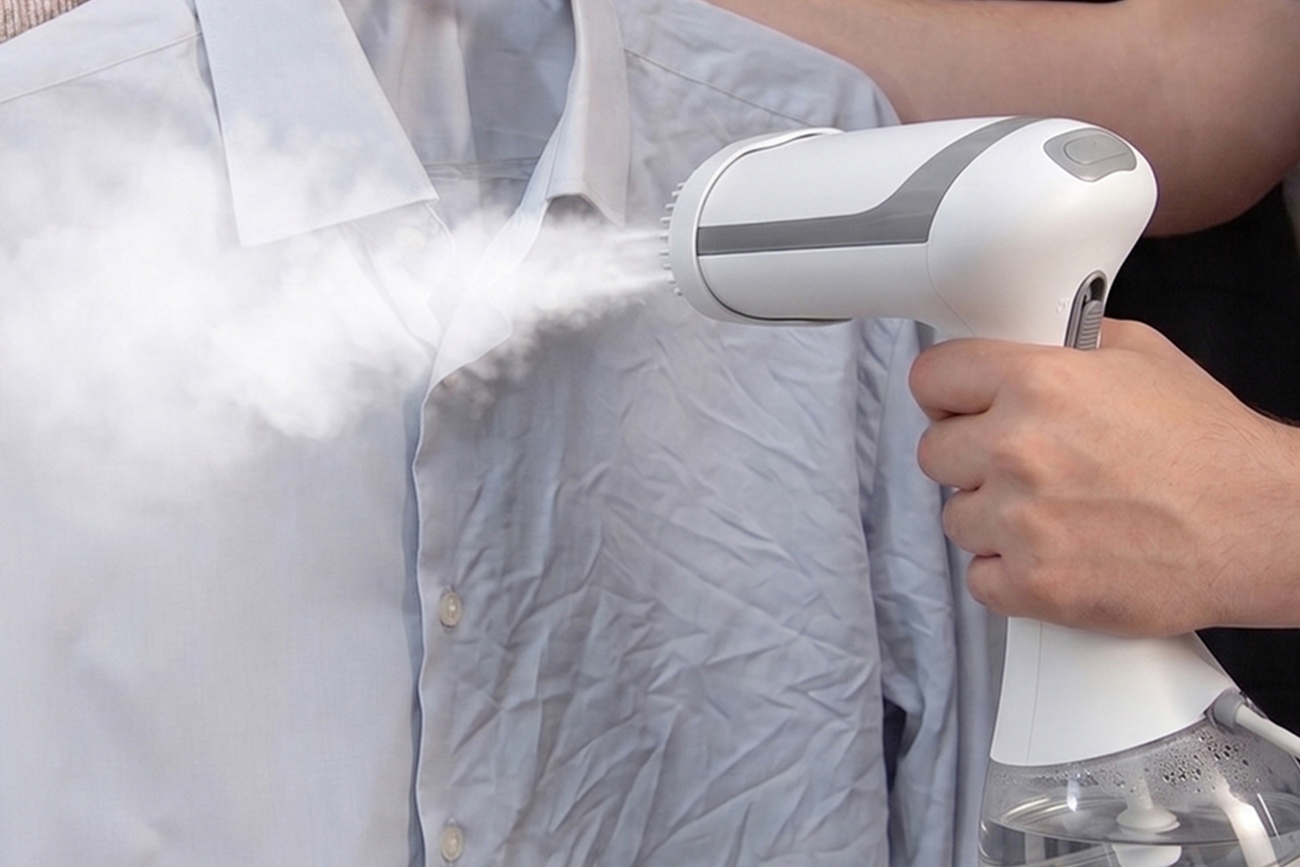
Picture this: it’s 7:15 on a Tuesday, the shirt you hung up last night still has a crease down the placket, and your meeting starts in an hour. 👔 I’ve been there — hauling out the ironing board, waiting for it to heat, then folding the whole thing away again, all for two shirts. That’s the morning a good clothes steamer is supposed to hand back to you.
Most people don’t realize how much tank size, steam control, and whether it presses as well as steams decide if a steamer gets used or shelved. Buy on wattage alone and you get a unit that needs refilling before the second dress ⚠️, or one that never flattens a collar. Watts tell you what goes in. What you feel is what comes out.
After testing more than 60 steamers, the one that changed my mornings is the Clorant Handheld Garment Steamer. It puts an 11.83 fl oz (350 mL) tank into a handheld body 💧, so five or six garments happen in one go instead of three trips to the sink. That’s the difference between a gadget and a routine.
This guide cuts through the wattage numbers to what actually changes your morning. You’ll learn why grams per minute tells you more than watts 🔥, and why a box that says travel tells you nothing about dual voltage. We’ve also flagged what to watch for: anti-spill claims that get read as leak-proof, and tanks too small for the job they’re sold for.
Whether you’re touching up one blouse before a meeting or working through a laundry-day pile of six, our top 5 garment steamers represent the best value across handheld and upright designs. Let’s dive into what separates these five from the rest of the clothes steamer aisle.

By Nadia Brooks
Nadia Brooks is a seasoned Home Textile Care Analyst with 8+ years of experience testing over 60 garment steamers. Specializes in performance evaluation of handheld and upright steamers for everyday household use.
Our Evaluation Standards
Tank Size and Refill Rhythm
Evaluated how many garments each unit handles before a refill, and how much that interrupts a laundry-day run
2-in-1 Steam and Press
Tested vertical steaming on a hanger against flat pressing on collars, plackets, hems and pleats
Steam Control and Fabric Range
Assessed continuous and on-demand steam, adjustable levels, and how each unit handled everything from linen to synthetics
Storage and Handling
Measured weight, size and wrist fatigue across a full session, and whether the unit fits a closet rather than a corner of the room

from Clorant
Overall Grade
A+
Rating
9.6/10
OVERALL ANALYSIS
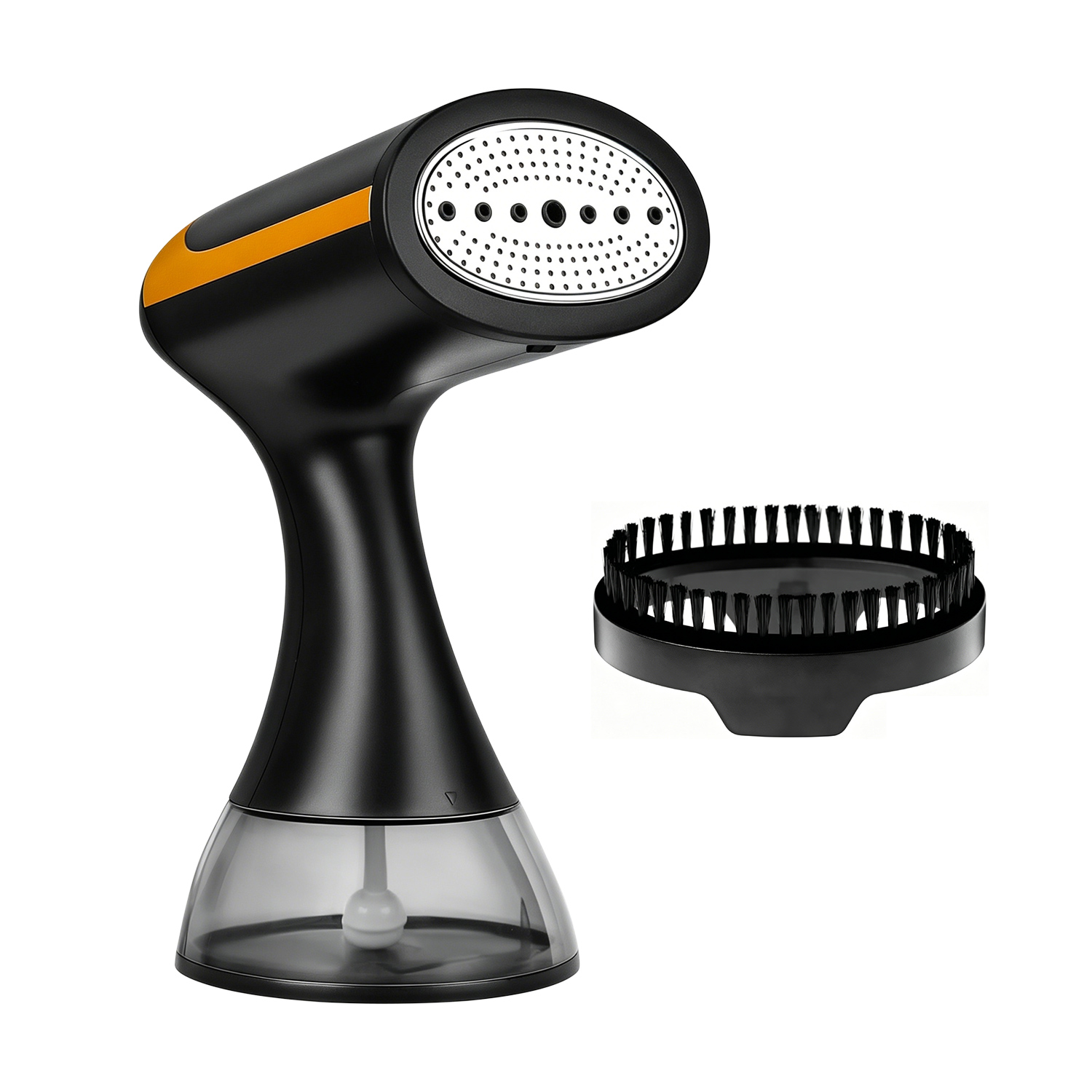
The Clorant Handheld Garment Steamer is built for the middle ground most households actually live in. Upright steamers want floor space; travel-size units want refilling every few minutes. This one puts an 11.83 fl oz (350 mL) tank into something you hold in one hand 👔.
That tank is what changes the rhythm. 1500W brings it up to steam in seconds, and a full fill carries a stack of five or six garments — shirts, skirts, a school uniform — without a trip back to the sink. Laundry day stops being three sessions and becomes one.
It steams and it presses. Hanging on a closet rod, vertical steaming drops the wrinkles out of a dress in a few passes; laid flat, the same head presses collars, plackets and hems the way steam alone never will. A multi-hole plate spreads heat across a wide face, so each pass covers more fabric.
Control is a slide and a button. Lock the slide and steam runs continuously 💨 down a long panel; release it and a tap of the button gives you short bursts for detail work, so you’re not holding a trigger for twenty minutes. Anti-spill construction and an anti-scald guard cover the two things that go wrong with steam in your hand.
Whether you’re rescuing one blouse before a meeting or clearing a laundry basket on a Sunday night, this steamer’s 2-in-1 handheld design means one tool covers both jobs at 1.78 lb (808 g). It lives on a closet shelf, not in a corner of the room.
Pros
11.83 fl oz (350 mL) tank – Five or six garments in one go, with no trip back to the sink
1500W, steam in seconds – Ready before the shirt is even on the hanger
Vertical and flat modes – One tool covers hanging wrinkles and pressed collars
Lock or tap the steam – Continuous down a long panel, short bursts for cuffs and hems
Multi-hole heating plate – A wider heated face means fewer passes per garment
Anti-spill and anti-scald build – Guards against drips on dark fabric and fingers near the plate
1.78 lb (808 g) – Light enough that your wrist lasts the whole stack
One machine for the whole closet – Cotton, linen, wool, silk, polyester and synthetics
Stores on a closet shelf – No ironing board, no floor space, no assembly
Cons
Occasionally out of stock due to strong demand
Delivery takes 1-2 days longer than major brands.
THE RESULT
The Clorant Handheld Garment Steamer stands out as 2026’s most complete handheld clothes steamer, combining a full-size tank with genuine 2-in-1 pressing. Its steam control 🏆 and closet-sized storage justify a quick decision before peak-season stock runs out.

from Jiffy
Overall Grade
B+
Rating
9.3/10
OVERALL ANALYSIS
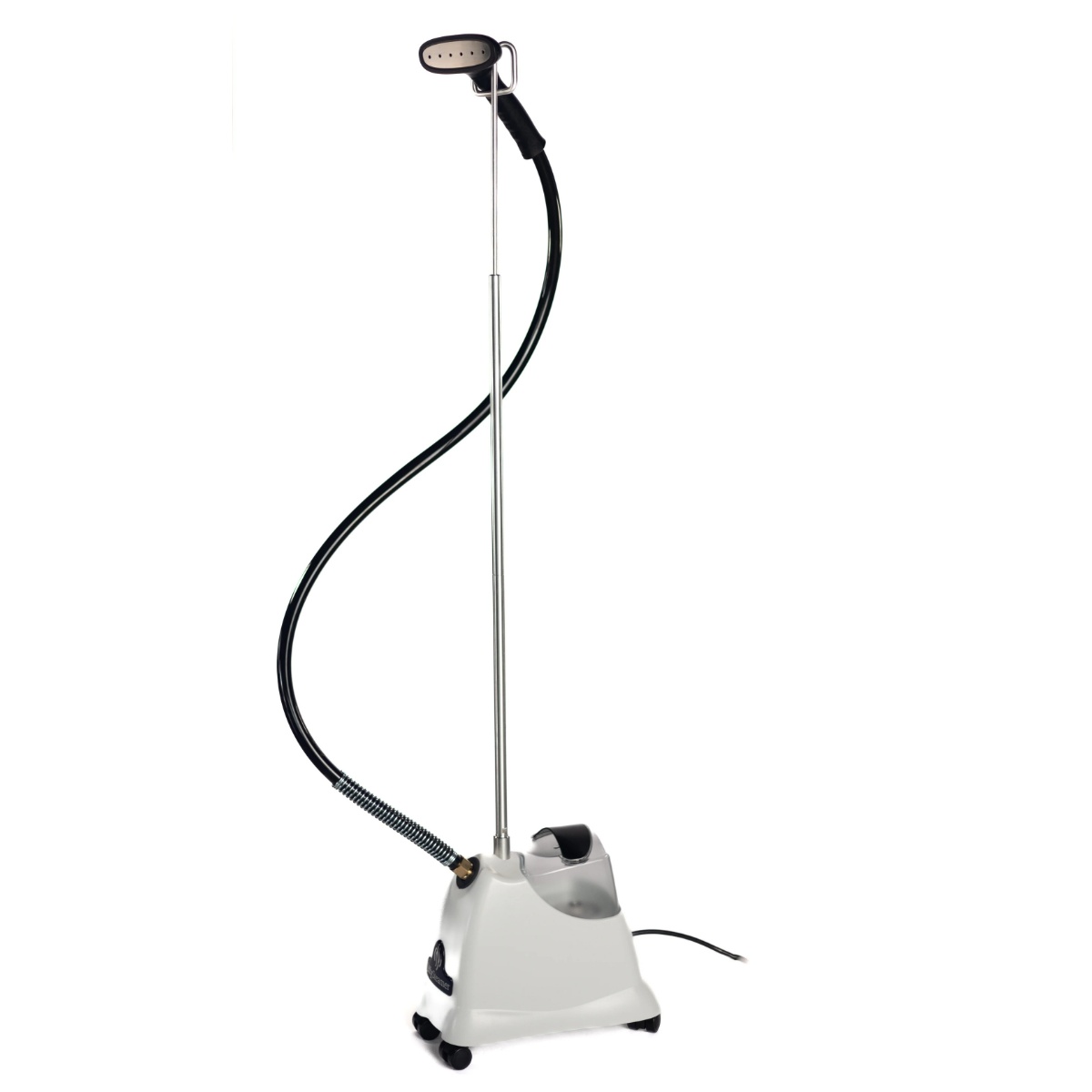
The Jiffy J-2000 Clothing Steamer is built for people who steam by the rack rather than by the garment. It’s a full-size upright with a ¾ gallon (2.8 L) tank, sized for stylists, photo studios and households that work through a whole closet in one session.
A 1300W stainless-steel heating element brings it up to steam in about a minute, and the tank takes a top-up mid-cycle rather than making you stop and cool it down 🧺.
A 5.5 ft hose on a 7 ft cord and a rolling base mean you guide the head instead of carrying the machine, which is what makes a 20 to 40 minute session possible at all. Brass fittings and a 3-year limited warranty put it in repair-it territory rather than replace-it territory.
What it costs you is space and reach. Assembled it stands 64 in tall, so there’s no closet shelf for it, the hose and handle warm up after about half an hour, the hose falls short of the top of 84 in curtains, and steam runs whenever it’s on with no trigger to pause between garments. It’s a strong buy for anyone with a permanent spot for it who steams in volume.
Pros
- ¾ gallon (2.8 L) tank – Sized for a full rack in one session
- Refill mid-cycle – Top it up without stopping to cool down
- Heats in about a minute – 1300W stainless-steel heating element
- 5.5 ft hose and rolling base – You guide the head, not the machine
- Brass fittings – Built to be repaired rather than replaced
- 3-year limited warranty – Long coverage for this category
- 7 ft cord – Reaches across a room without an extension
Cons
- 64 in assembled – Needs a permanent spot, not a closet shelf
- Hose and handle warm up – Noticeable after about half an hour of steady use
- No on-demand steam – Steam runs while it’s on, with no trigger to pause it

from Rowenta
Overall Grade
B+
Rating
9.0/10
OVERALL ANALYSIS
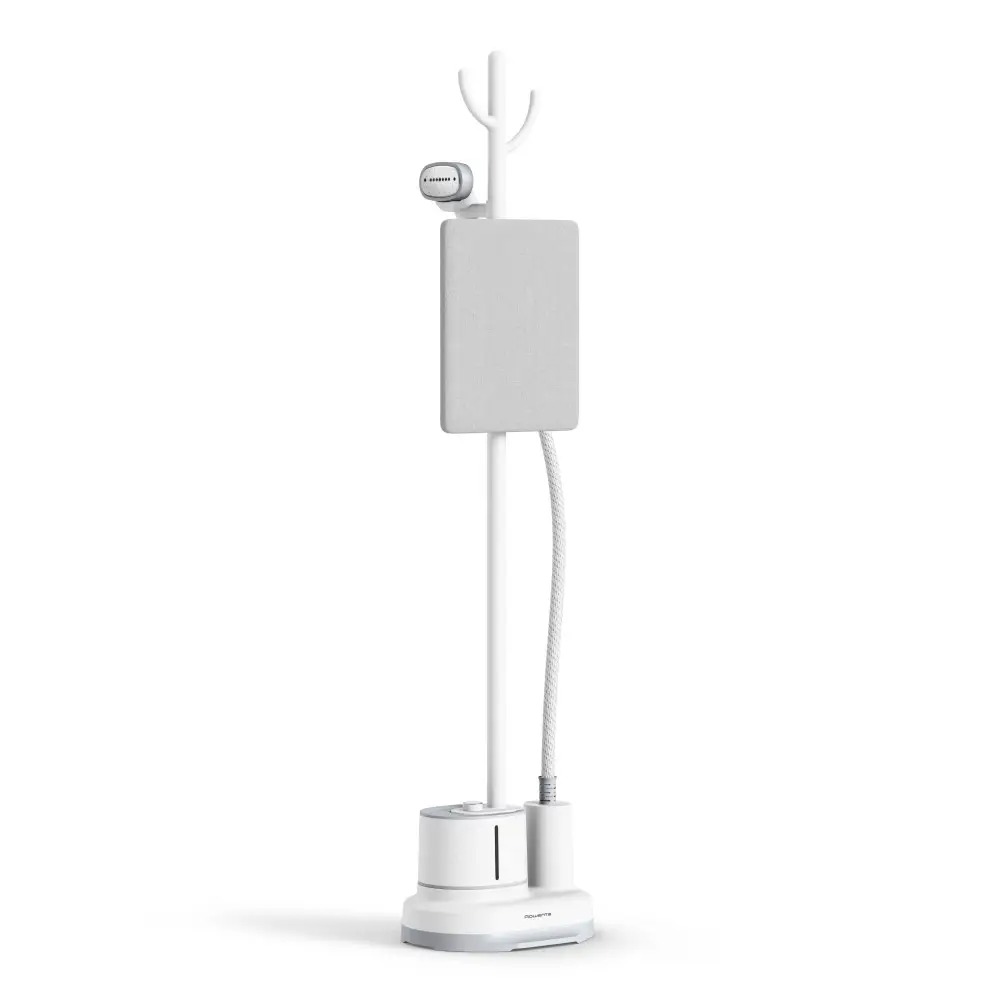
The Rowenta Pro Style Care IS8440U1 is built for households that steam a batch at a time in a fixed laundry or dressing area. At 1700W it’s a premium full-size upright, and it publishes the number that actually predicts performance.
That number is 35 g/min of continuous steam 💨 — an output figure rather than an input one. It reaches steam in 45 seconds, a 44 oz (1.3 L) removable tank runs about 35 minutes per fill, four steam levels cover delicates through heavy cotton, and an anti-calc draining system with auto-off handles the maintenance side.
The trade is footprint and technique. At 64.4 in and 10.6 lb it needs dedicated floor space, retail reviews repeatedly report hot water dripping when the hose sits wrong or condensation builds, owners say the plastic parts don’t match the price, and a steamer still won’t give you the crisp crease an iron does. It’s a good fit for people who steam in volume and have somewhere to keep it standing.
Pros
- 35 g/min continuous steam – A published output figure, not just wattage
- 44 oz (1.3 L) removable tank – About 35 minutes of steaming per fill
- Four steam levels – Delicates through heavy cotton on one machine
- Steam & Press vertical support – Hold fabric taut while you work the head
- 45-second heat-up – Ready before the first garment is on the hanger
- Anti-calc draining and auto-off – Maintenance and safety built in
Cons
64.4 in and 10.6 lb – Needs dedicated floor space
Dripping reports – Hot water can escape when the hose sits wrong
No iron-crisp finish – Sharp collars and creases still want an iron
Plastic parts at a premium price – Owners flag the finish on the support and screen

from Conair
Overall Grade
C+
Rating
8.6/10
OVERALL ANALYSIS
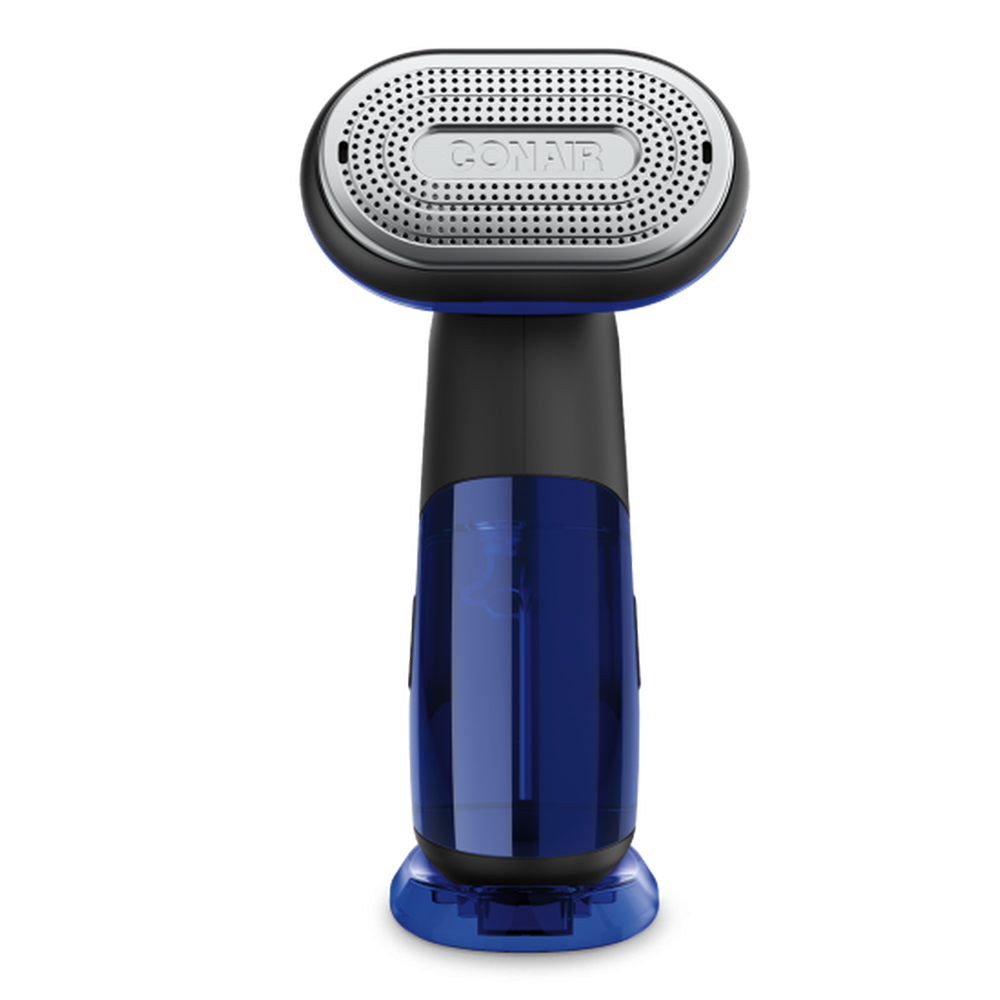
The Conair Turbo ExtremeSteam GS108 is built for people who want adjustment rather than a single steam setting. At 1875W it sits at the top of the handheld power range, with a Turbo setting for the passes that need it.
Four adjustable steam settings let you drop the output for silk and raise it for heavy cotton 🎚️, and an extra-large aluminum soleplate covers both jobs — vertical steam on the hanger, horizontal dry ironing for collars, plackets, hems and pleats.
A Smart Sensor cuts the steam when the plate rests on a flat surface and restarts it when you lift, the box includes a delicates bonnet, creaser, silicone band and bristle brush, and the cord runs 8 ft.
Weight is the complaint owners raise most, and the tank is small enough that a few pairs of slacks or one dress can send you back to the sink. The reservoir is awkward to remove, there are scattered reports of spitting and leaking, and at 120V only it doesn’t travel outside North America. It’s a sensible pick for people who want steam levels and pressing in one hand and will carry the weight for them.
Pros
- 1875W with Turbo – Power on tap for heavy cotton and denim
- Four steam settings – Silk through canvas on the same unit
- Extra-large aluminum soleplate – Real dry ironing, not just steam
- Smart Sensor – Steam stops on a flat rest and restarts when you lift
- Four accessories included – Delicates bonnet, creaser, silicone band and brush
Cons
Heavy in the hand – The complaint owners raise most often
Small tank – A few slacks or one dress can mean a refill
Awkward reservoir – Owners describe it as fiddly to remove and refit
Spitting and leaking reports – Scattered but consistent in owner feedback
120V only – Not dual voltage, so it stays in North America

Overall Grade
C
Rating
8.1/10
OVERALL ANALYSIS
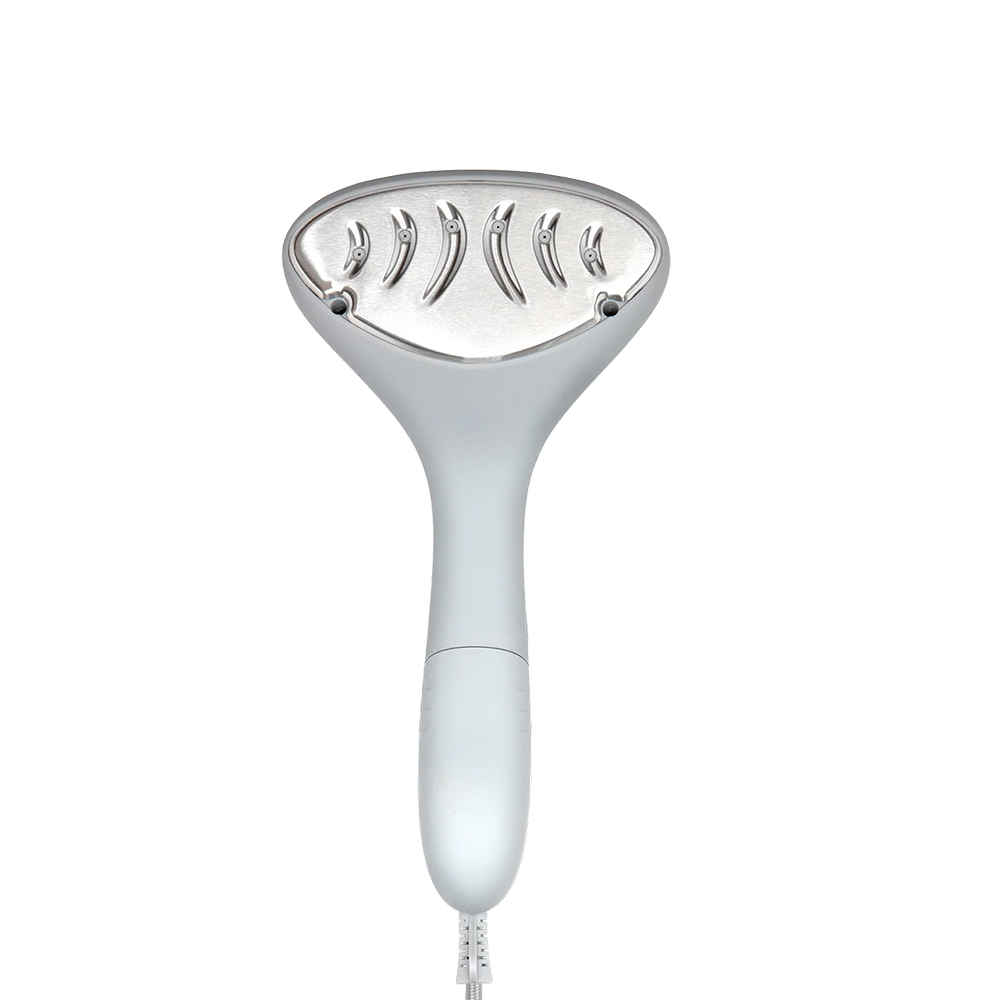
The Steamery Cirrus 2 Handheld Steamer is built for people who steam one to three garments at a time and notice every ounce. At 1.72 lb and 13.0 × 5.9 × 3.7 in, it’s the one you leave out on a shelf rather than pack away.
Its method sets it apart. A stainless-steel heated front plate produces dry steam 👗, so you rest the plate against the fabric and slide, which suits blouses, dresses and delicates better than a blast of wet steam. Output is a published 15 g/min (0.53 oz/min), and it heats from cold in about 25 seconds.
It runs on 110–120V only. That’s fine at home, but it isn’t dual voltage, so it doesn’t cross to Europe with you however packable it looks.
The tank is the real limit. At 3.04 fl oz (90 mL) refills interrupt anything past a garment or two, there’s one steam mode with no extra output for thick cotton or denim, and the fill opening is small with a water level that’s hard to read. It’s built to steam rather than press, which makes it a reasonable pick for a small, well-kept wardrobe where weight matters more than volume.
Pros
- 1.72 lb and 13 in long – Light enough to use one-handed for a full session
- Dry steam, stainless front plate – Rest and slide, made for delicates
- 15 g/min published output – A real figure rather than a wattage claim
- About 25 seconds to heat – Faster from cold than most uprights
Cons
- 3.04 fl oz (90 mL) tank – Refills interrupt anything past a garment or two
- One steam mode – No extra output for thick cotton or denim
- Small fill opening – Awkward to fill, and the water level is hard to read
- 110–120V only – Not dual voltage despite the packable size
- Steams more than it presses – Sharp collars and creases still want an iron
❓What Are Garment Steamers?
A garment steamer is a handheld or upright appliance that pushes hot steam through fabric to relax the fibers so wrinkles fall out, usually while the garment hangs on a rod or a hook. The difference from an iron is contact: an iron flattens with heat and pressure against a board, while a steamer works from a short distance or a light touch.
Two formats dominate. Handheld clothes steamers hold roughly 3 to 12 fl oz and store on a closet shelf, while full-size uprights hold a liter or more, stand on a rolling base and are built for long sessions. The choice between them is less about power than about batch size, storage and how long you want to hold something in your hand.
The number that predicts performance is steam output in grams per minute, not the wattage on the box. Watts describe what goes in; grams per minute describes what reaches the fabric, along with plate design and how steadily the flow holds through a session.
One rule holds whatever you buy: the care label wins. Silk, velvet, leather, suede and coated fabrics each have their own limits, and no steamer is safe for every material regardless of what the packaging says.
🎯 Key Features & Advantages: Garment Steamers
No Ironing Board Required: Steam the garment where it already hangs, on a closet rod or the back of a door.
Faster Than Setting Up an Iron: Most units reach steam in under a minute, so two shirts take minutes instead of a whole setup.
Gentler on Delicates: Steam relaxes fibers without pressing a hot plate onto silk, wool or embellished fabric.
Works on More Than Clothes: Curtains on the rod, bedding, upholstery and table linen all steam in place.
Freshens Between Washes: Steam lifts odors and light creases, which stretches the time between dry-cleaning trips.
Fixes Suitcase Creases: A hotel hanger and ten minutes undo what a folded blazer picked up overnight.
2-in-1 Models Press Too: Flat modes handle the collars, plackets and hems that steam alone leaves soft.
Stores in a Closet: Handheld units go on a shelf instead of claiming a permanent corner of a room.
🔍 Smart Buying Guide: Garment Steamers
Tank Size Against Your Pile: Match capacity to how many garments you do at once; a small tank turns one session into three.
Steam Output, Not Wattage: Look for grams per minute wherever a maker publishes it, because watts alone tell you very little.
Steam Control: Continuous steam suits long panels, on-demand bursts suit detail work, and adjustable levels cover a mixed closet.
Steam, Press, or Both: If collars and hems matter to you, a flat mode or a soleplate is worth more than extra wattage.
Weight in the Hand: Water is heavy, so a full tank adds to the load — check the weight filled, not empty.
Voltage Before Travel: Most US models are 120V only, so confirm dual voltage before you plan a trip around one.
Water and Descaling: Hard water builds scale that cuts output, so check how the unit drains and how often it needs it.
⚠️ Smart Shopper Alert: Garment Steamers
Reading Wattage as Steam: A high wattage number guarantees nothing on its own; output, plate design and flow stability decide the result.
Assuming a Bigger Tank Is Free: 350 mL of water adds real weight to your hand, so capacity and wrist fatigue have to be weighed together.
Taking Anti-Spill as Leak-Proof: Angle, condensation, overfilling and scale can all cause spitting, whatever the label claims.
Treating Travel as Dual Voltage: Portable and dual voltage are different things, and most US units run on 120V alone.
Assuming All Fabrics Are Fair Game: Silk, velvet, leather, suede and coated finishes each need checking against the care label first.
By Nadia Brooks
Nadia Brooks is a seasoned Home Textile Care Analyst with 8+ years of experience testing over 60 garment steamers. Specializes in performance evaluation of handheld and upright steamers for everyday household use.