In-Depth Product Analysis for Informed Consumer Choices

Best 5 Portable CD Players of 2026
Press Play Without Plugging Anything In
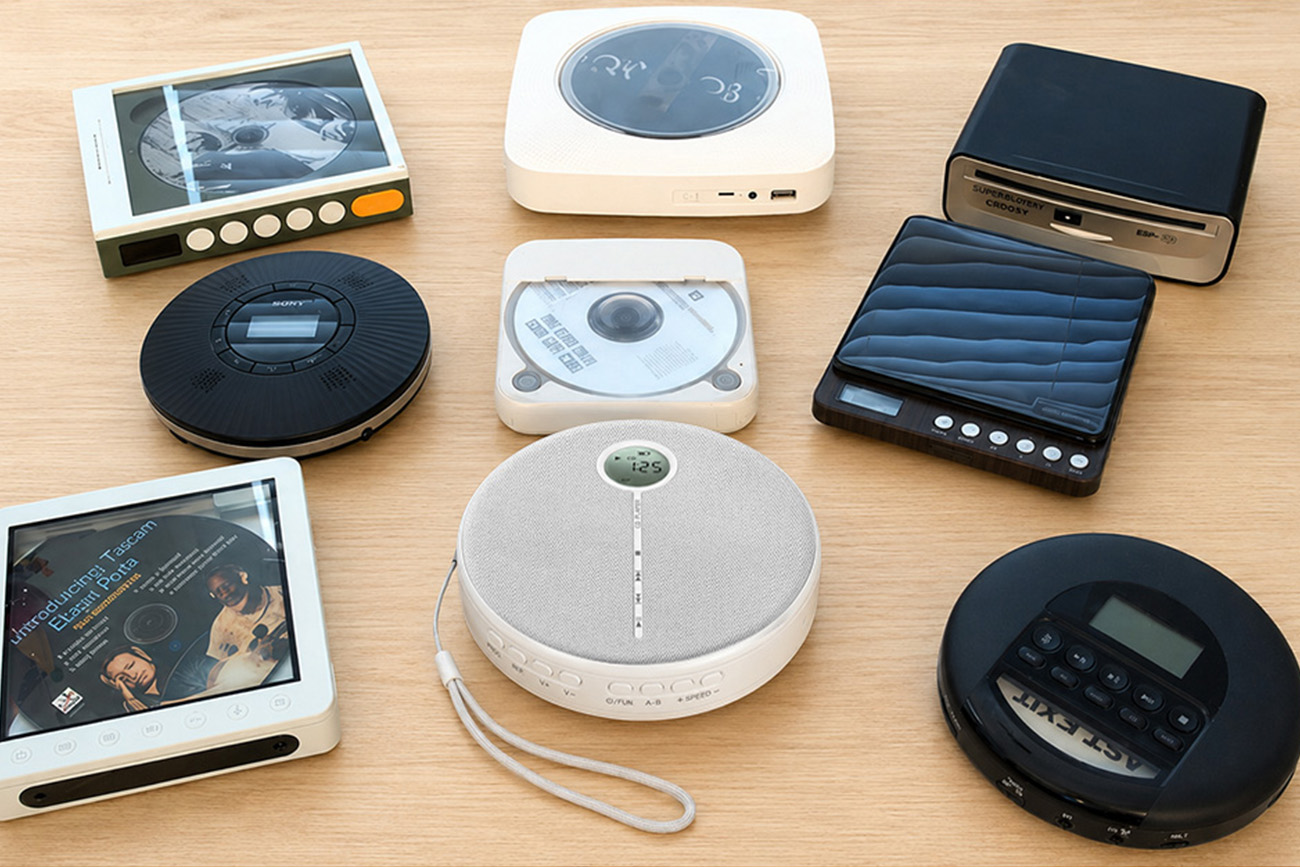
Picture this: you’re standing in front of a shelf of CDs 💿 you bought in the nineties and have moved twice since, and nothing left in the house will play them. I’ve been there — I bought a cheap player, then headphones for it, then a small speaker so anyone else could hear, and ended up with a pile of gear to play one album.
Most buyers don’t realize how much onboard speakers, skip protection, and the way a player remembers your place decide whether it gets used or ends up in a drawer ⚠️. Buy on the feature list alone and you get a player that stays silent until something is plugged into it, or one that restarts your audiobook at track one every morning.
After testing more than 35 portable CD players, the one that asks the least of you is the Clorant Portable CD Player. It has stereo speakers built into the shell 🎵, clear at the volume you’d actually use, so it plays the moment you press the button — and it takes a disc, a USB flash drive or a Bluetooth connection from your phone without swapping to a second device.
This guide cuts through the spec sheets to what decides whether a player fits your week. You’ll learn why the word Bluetooth never tells you which direction it works 🔌, and why a rated “up to” battery figure changes completely depending on whether you listen through speakers or headphones. We’ve also flagged what to watch for: resume that remembers only the track number, and skip protection sold as a fix for scratched discs.
Whether you’re bringing an old collection back to life or working through language CDs at a desk, our top 5 portable CD players represent the best value across all-in-one and Hi-Fi designs. Let’s dive into what separates these five from the bargain player that needs three accessories before it makes a sound.

By Roland Petrie
Roland Petrie is a seasoned Portable Audio Analyst with 3+ years of experience testing over 35 portable CD players. Specializes in performance evaluation of players that work without headphones or an external speaker.
Our Evaluation Standards
Playing Without Anything Plugged In
Measured what each player does on its own, with no headphones, no external speaker and no wall outlet
Sound Quality Where You Actually Listen
Judged how each one sounds from a kitchen counter or a desk, using only what comes in the box
Resume and Everyday Controls
Checked whether resume returns you to the exact spot, and how many presses a simple change of source takes
Skip Protection and Battery Life
Tested skip protection over rough pavement and at walking pace, and how long a charge lasts in real playback

from Clorant
Overall Grade
A+
Rating
9.6/10
OVERALL ANALYSIS
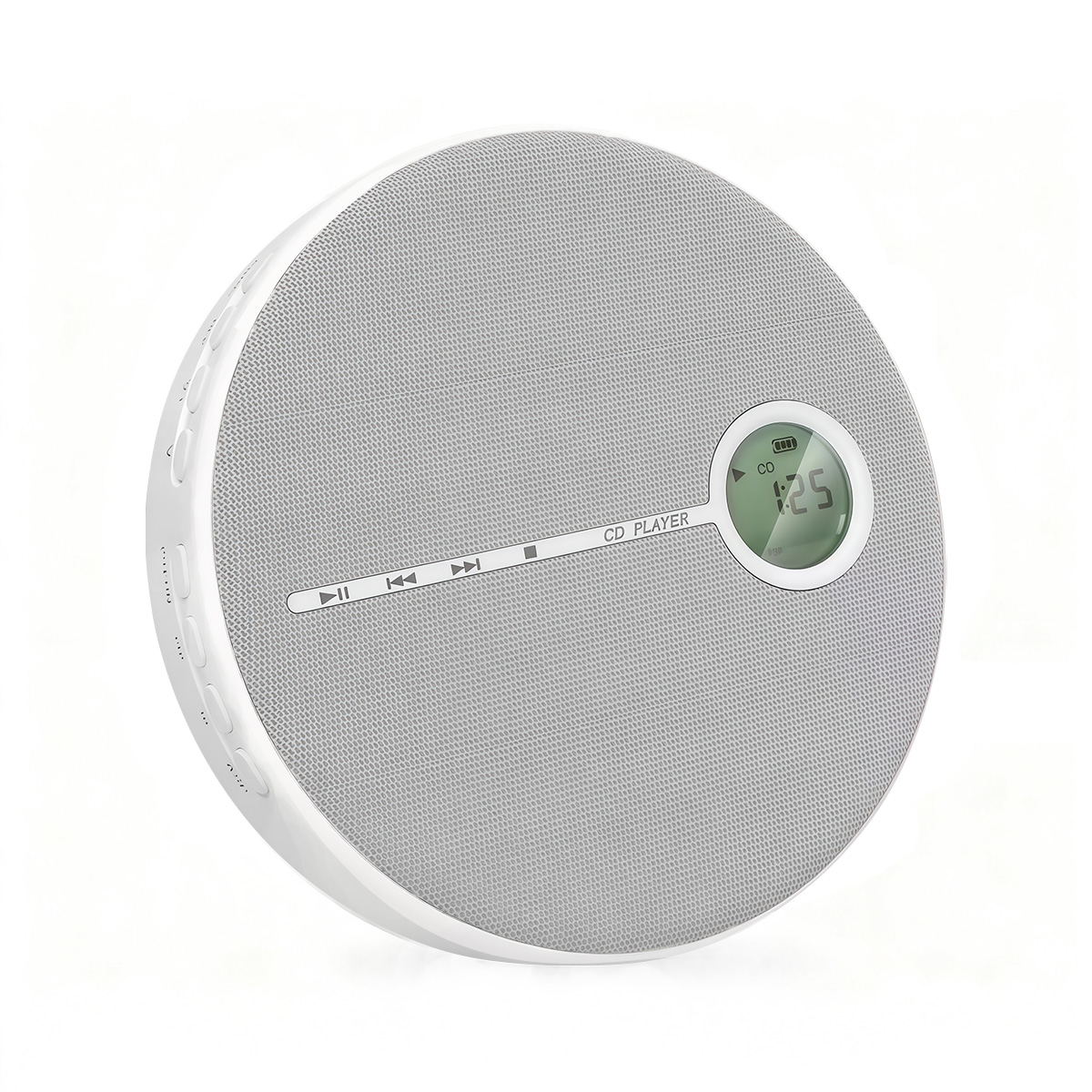
You press the button and music comes out. The Clorant Portable CD Player has stereo speakers built into the body 🔊, so there’s no hunting for headphones before the first track and nothing to pair before breakfast — set it on a kitchen counter or a workbench and it’s one thing sitting there, not a small system you have to put together first.
You can follow an audiobook with the water running. The built-in stereo pair stays clear rather than boxy at counter and desk distance, so dialogue holds together over kitchen noise, and music keeps its punch when you push past background level instead of thinning out.
Your old discs and your phone finally live on the same machine. A CD goes in the top, a USB flash drive plugs in for MP3 and WMA files, and Bluetooth picks up whatever is playing on your phone or tablet, so going from a 1994 album to this morning’s podcast is a change of mode rather than a change of hardware.
You can set it on the passenger seat and everyone in the car hears it. Anti-skip protection reads ahead into a buffer so expansion joints and speed bumps don’t turn into gaps 🚗, and the 2000mAh battery charges over USB from a laptop, a car charger or a power bank, so there’s no drawer of AA cells to keep stocked and no fight for the one free outlet.
Whether you’re working through a language course at a desk or finishing an audiobook on the road 📖, the Last Memory function holds your position when you switch off, so the next session picks up where it stopped instead of at the start of the disc. One multi-function button covers track, volume and mode, so you’re not looking anything up in a manual.
Pros
Built-in stereo speakers play with nothing plugged in
Disc, USB drive and phone audio on one machine
Plays a disc with nothing to pair or connect first
Reads MP3 and WMA files off a USB flash drive
Anti-skip protection holds the track over bumps and walking
Last Memory returns an audiobook to where you stopped
2000mAh battery instead of a drawer of AA cells
Charges from a laptop, car charger or power bank
One multi-function button for track, volume and mode
Clear, full stereo sound at counter and desk distance
Cons
Occasionally out of stock due to strong demand
Delivery takes 1-2 days longer than major brands.
THE RESULT
The Clorant Portable CD Player stands out as 2026’s most complete everyday player: clear stereo sound from speakers in the shell, disc, USB and Bluetooth playback, anti-skip protection and a rechargeable battery, all working out of the same box with nothing to add. Press the button and it plays 🏆, which makes this an easy decision before peak-season stock runs out.

from SHANLING
Overall Grade
B+
Rating
9.3/10
OVERALL ANALYSIS
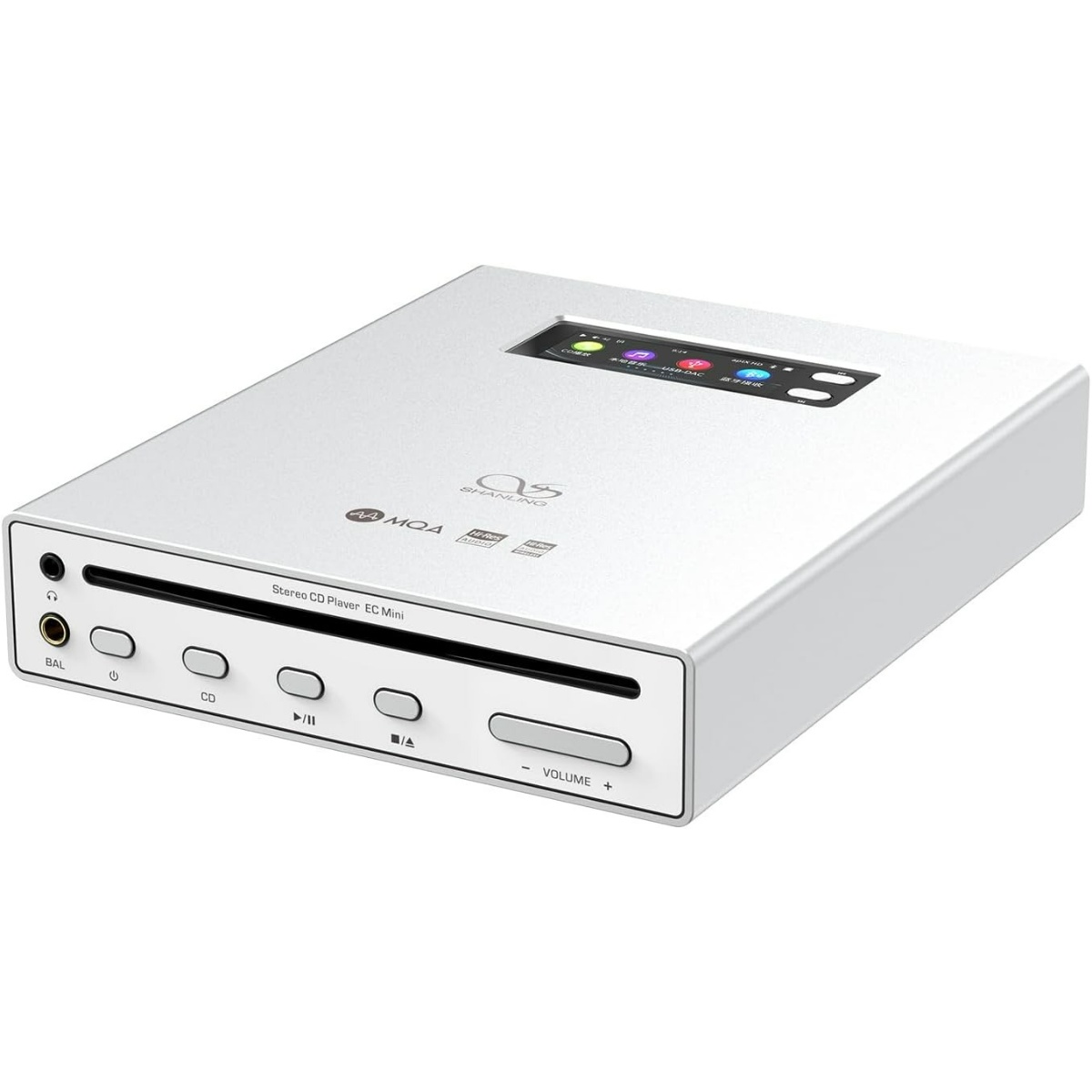
The SHANLING EC Mini is the one to look at if a CD is a source for a real Hi-Fi chain. Dual ESS ES9219 DACs feed 3.5mm, 4.4mm balanced and RCA line-out, so it drives demanding headphones and hands a clean signal to a desktop amplifier.
It’s a digital player as much as a disc player. A MicroSD slot and USB drive support take it up to 32-bit/384kHz and DSD256 🎧, it works as a USB DAC or a pure CD transport, and two-way Bluetooth 5.0 takes LDAC in and sends LDAC or aptX back out.
Runtime splits by source. CD playback runs about 7.5 hours while MicroSD playback stretches to roughly 25 hours, and a 2.33-inch touchscreen handles the menus alongside a set of hardware buttons.
The size is the first thing you notice. At roughly 9.8 × 8.1 × 2.0 in and 2.6 lb, it’s a desk machine rather than something you drop into a bag, and the slot-loading mechanism is audibly mechanical in a quiet room. Reviewers and owners both describe small gaps between tracks where a disc should run straight through, with the occasional tick on live and classical recordings, and the menu system draws steady complaints for taking a while to learn. There are no built-in speakers at all, so headphones or an external system are part of the purchase. It’s a strong buy for a listener with good headphones and a desk to put it on, as long as portability isn’t what you’re paying for.
Pros
- Dual ESS ES9219 DACs with 4.4mm balanced output
- 3.5mm, 4.4mm and RCA line-out for desktop systems
- MicroSD and USB playback up to 32-bit/384kHz
- Works as a USB DAC or a CD transport
- Two-way Bluetooth 5.0 with LDAC and aptX
- About 25 hours of MicroSD playback per charge
- 2.33-inch touchscreen alongside hardware buttons
Cons
About 2.6 lb, closer to a desk unit than a portable
No built-in speakers, so headphones or a system are required
Small gaps between tracks where a disc should run straight

from FiiO
Overall Grade
B+
Rating
9.0/10
OVERALL ANALYSIS
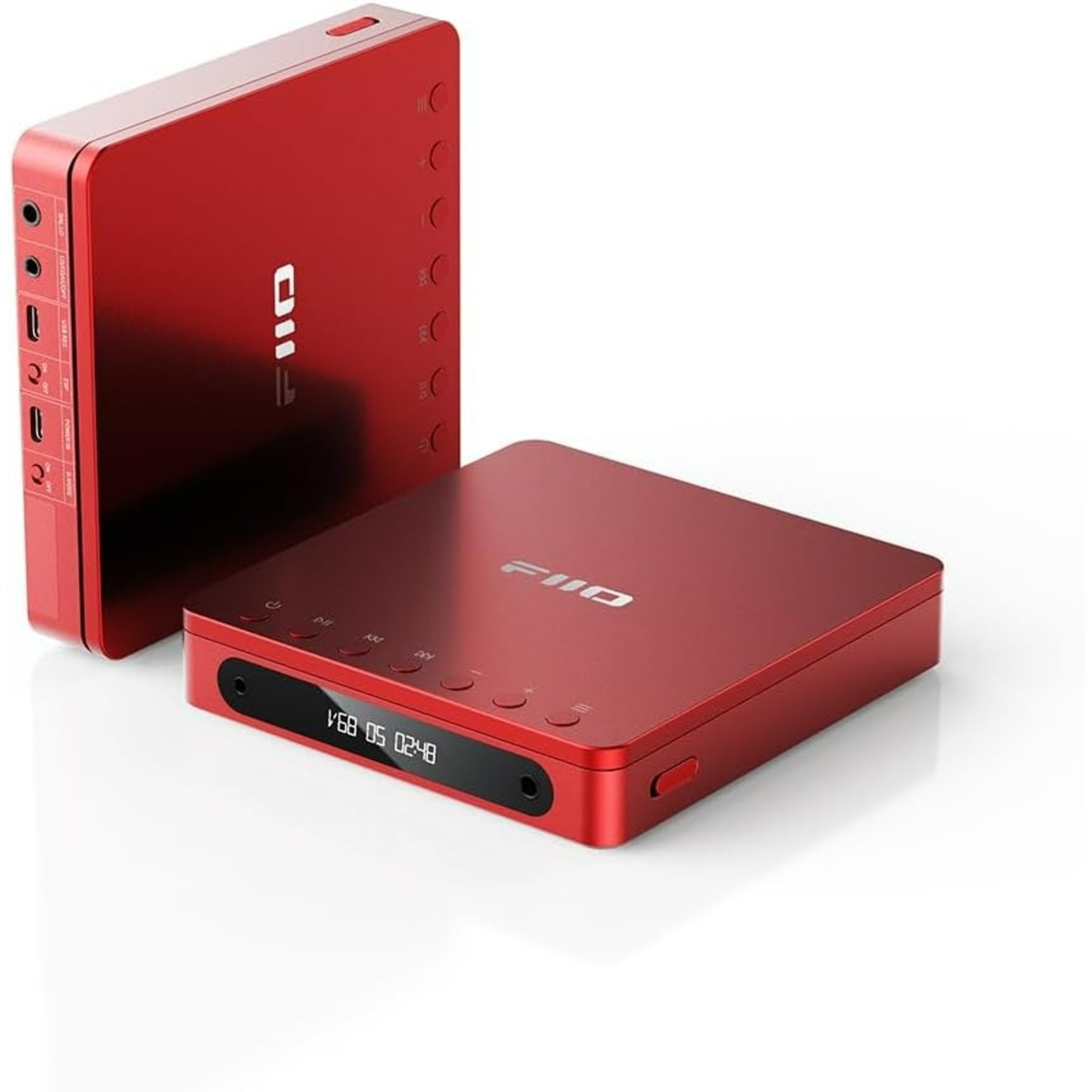
The FiiO DM13 BT is the one that turns discs into files. USB ripping writes a CD straight to WAV, optical and coaxial outputs feed an external DAC, and it doubles as a CD transport for a system you already own.
Headphone drive is the other half of it. Dual CS43198 DACs push 660mW per channel at 32Ω from the 4.4mm balanced output 🎚️, the aptX HD and aptX Low Latency transmitter works with good wireless headphones, and Desktop Mode runs the player off USB power so the 3750mAh battery isn’t cycling while it sits on a desk.
At 5.4 × 5.7 × 1.1 in and 15.9 oz it’s square and dense enough that reviewers treat it as home gear, and measured runtime lands nearer 8 hours than the 10 on the spec sheet. There are no built-in speakers, so every listen starts by plugging something in. FiiO’s own documentation notes that the portable mechanism won’t read every disc, with occasional frame skipping on CD-R and CD-RW, and the secondary functions run on button combinations that take some learning. It’s a good fit for someone building around a DAC and a serious pair of headphones, as long as you don’t mind that nothing plays until it’s connected.
Pros
USB ripping writes CDs straight to WAV files
Optical and coaxial digital outputs for an external DAC
Dual CS43198 DACs with 660mW at 32Ω balanced
aptX HD and aptX Low Latency wireless transmission
3750mAh battery with Desktop Mode on USB power
60-second CD and 120-second MP3 skip buffer
Cons
No built-in speakers, so something plugs in every time
Measured runtime closer to 8 hours than the rated 10
Square 15.9 oz body that reviewers treat as home gear
CD-R and CD-RW discs can skip frames

from MEGATEK
Overall Grade
C+
Rating
8.6/10
OVERALL ANALYSIS
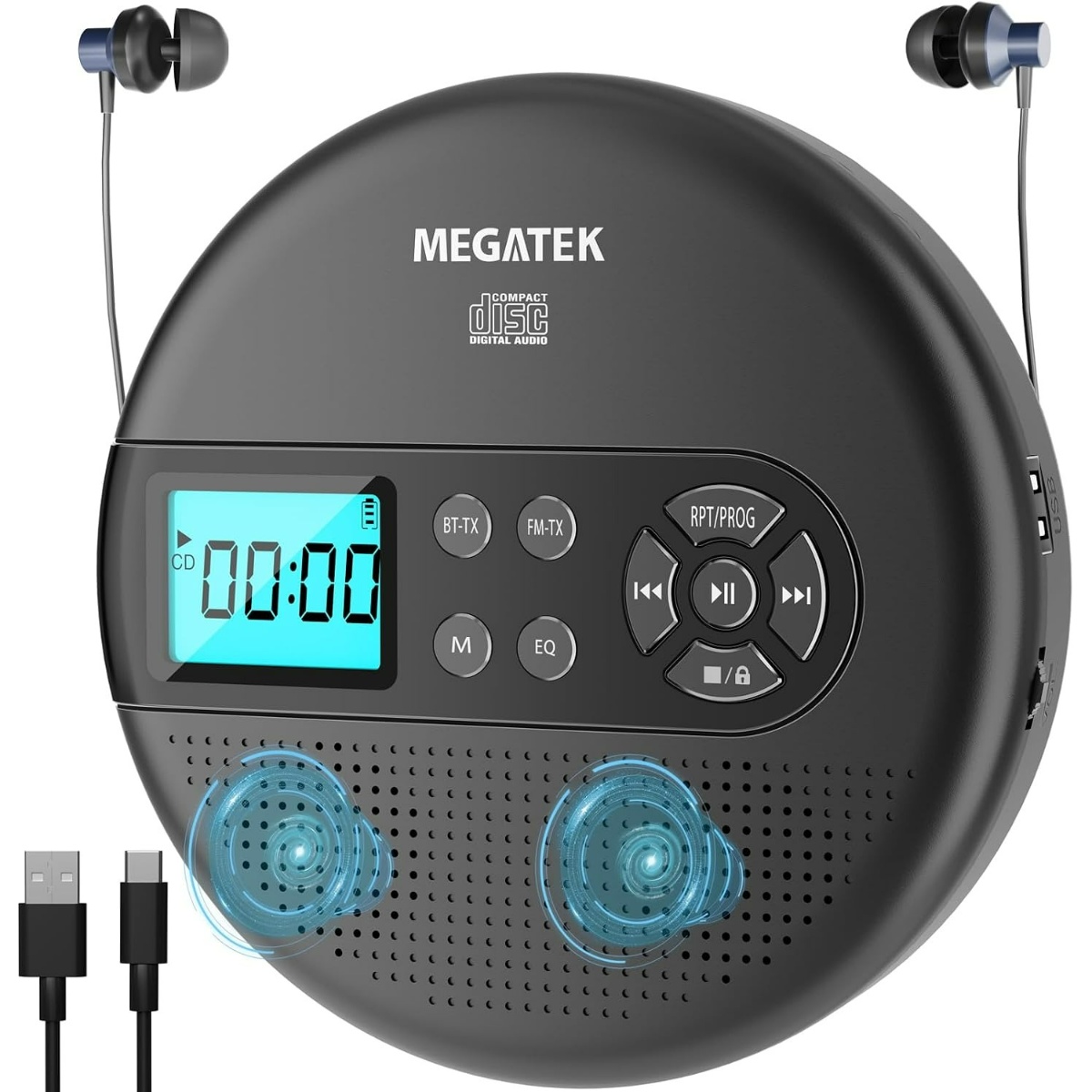
The MEGATEK CP27BR is the budget route from a disc collection back into a car 📻. A built-in FM transmitter broadcasts across 87.5–108MHz to the car radio, and Bluetooth works in both directions, in from a phone and out to headphones or a speaker.
The basics are all here. Two 1.5W stereo speakers sit in a 5.7 × 5.7 × 1.3 in shell at 10.9 oz, there’s 60-second anti-skip and resume play, and the disc side reads CD, CD-R/RW, MP3 CD and audiobook discs while USB handles MP3, WMA and WAV.
Power is straightforward. A 2000mAh lithium-polymer pack charges in three to four hours, and the manual puts playback at roughly 6 hours on disc and 8 on USB.
Two-way Bluetooth doesn’t mean two-way with your car. The manual says plainly that not every car stereo is supported, and it’s the gap owners run into most often; the FM transmitter is the fallback, and how cleanly it works depends on how crowded the local dial already is. Marketing material elsewhere claims up to 15 hours, which doesn’t line up with the manual’s own figures, and owners report the battery indicator dropping off quickly near the end of a charge. The small speakers turn bright and thin once you push the volume, and a few owners hit compatibility limits on large MP3 discs. It’s a sensible pick for a budget-first buyer whose main goal is the car, as long as you confirm your stereo will actually pair.
Pros
FM transmitter puts discs through a car radio
Two-way Bluetooth, in from a phone and out to headphones
Two 1.5W stereo speakers in a 10.9 oz shell
- Reads CD, CD-R/RW, MP3 CD and audiobook discs
- 60-second anti-skip with resume play
Cons
Not every car stereo will pair over Bluetooth
FM transmission depends on a clear local frequency
Battery claims elsewhere don’t match the manual’s figures
Speakers turn bright and thin at higher volume
Large MP3 discs hit compatibility limits for some owners

Overall Grade
C
Rating
8.1/10
OVERALL ANALYSIS
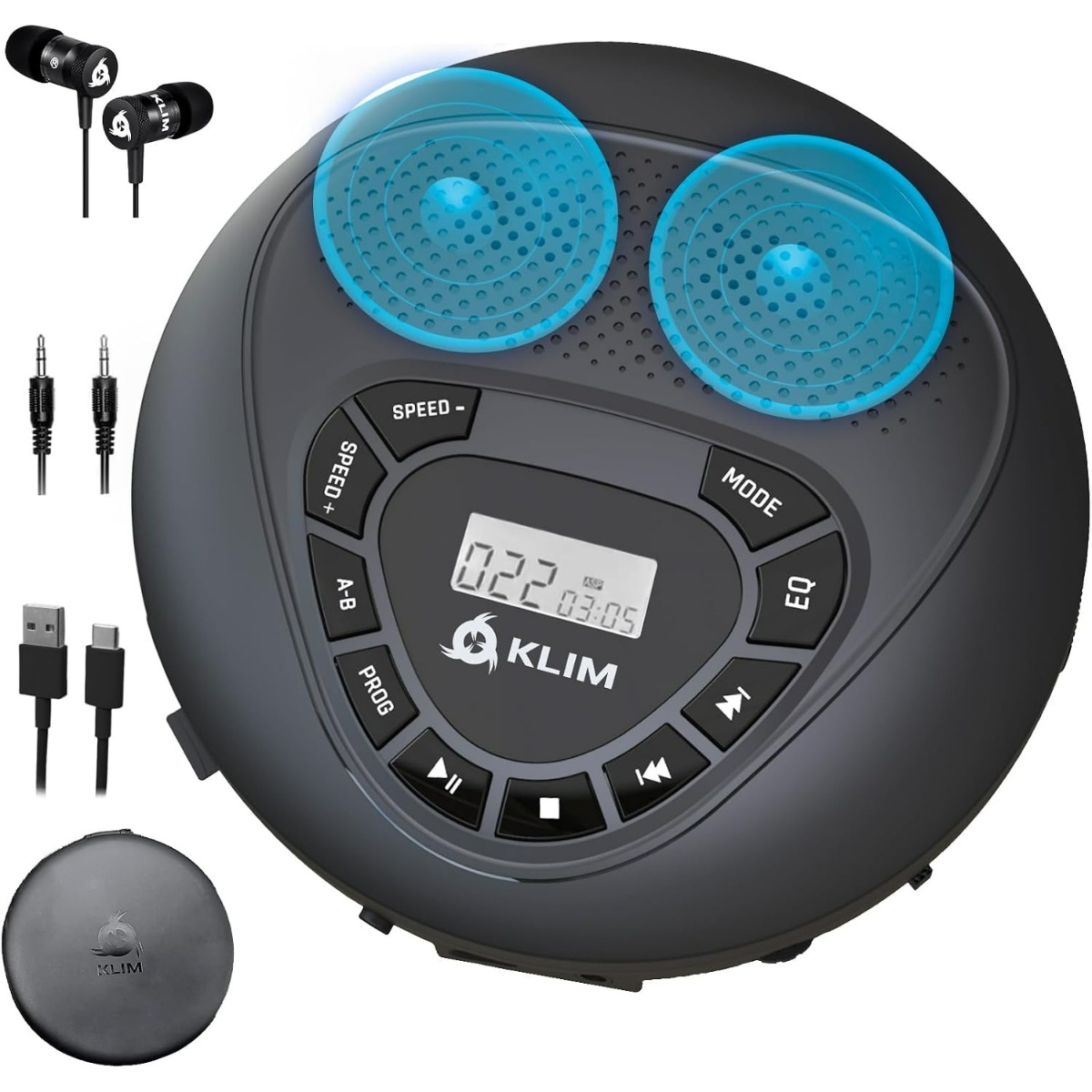
The KLIM Speaker is built for people studying from a disc. Speed control and A-B repeat let you slow a passage down and loop it, five EQ presets shape the tone, and Last Memory holds your spot between sessions.
It travels light. The shell measures 5.6 × 5.6 × 1.1 in at roughly 8.5 oz 🎒, a TF card up to 32GB adds MP3 and WMA files alongside the disc, and skip protection buffers 40 to 100 seconds on audio CDs and 120 to 180 on MP3 discs.
The package covers more than the player itself. KLIM includes earphones, a carry bag and an AUX cable, and backs the player with a five-year warranty and a 30-day return window, which takes some of the risk out of a first purchase.
Battery life splits sharply by how you listen. KLIM puts headphone use at 8 to 13 hours but built-in speaker use at only 4 to 6, so a day of playing out loud means the charger travels with you. Owners call the speakers fine up close, but short on volume and low end beyond that. The Bluetooth here connects outward to a speaker or a car system rather than taking audio in from a phone, and KLIM states that infotainment compatibility can’t be guaranteed. TF card browsing works by track number rather than folders, and a small number of owners report the lid catch, the display or a button failing after some use. It’s a reasonable pick for a language learner or an audiobook listener, as long as you plan around the speaker-mode battery.
Pros
- Speed control and A-B repeat for study and practice
- TF card up to 32GB alongside CD, CD-R, HDCD and MP3
- 40 to 100 second skip buffer on audio CDs
- Five-year warranty with earphones, carry bag and AUX cable
Cons
- Built-in speaker runtime drops to 4 to 6 hours
- Speakers run short on volume and low end
- Bluetooth sends audio out rather than taking it in
- Car system compatibility isn’t guaranteed
- TF card browsing works by track number, not folders
❓What Is a Portable CD Player?
A portable CD player is a battery-powered disc player small enough to carry, and in 2026 most of them do more than spin a CD. The useful ones add a USB or memory card slot, Bluetooth, and in some cases speakers built into the shell, which is what decides whether the player is a complete device or one part of a setup.
Bluetooth is the word that causes the most confusion, because it has a direction. A receiver takes audio in from your phone and plays it through the player. A transmitter sends the player’s own audio out to wireless headphones, a speaker or a car stereo. Plenty of listings say Bluetooth and never say which, and the two are not interchangeable.
Anti-skip has a specific job as well. Skip protection reads ahead into a buffer so a bump doesn’t interrupt the music, and it’s measured in seconds — 60 on some players, up to 180 for MP3 discs on others. It does nothing for a scratched disc, a badly burned CD-R or a drive that can’t read a particular format.
Two more things worth knowing. Resume varies in precision: some players remember only the track number, others return to the exact second, and for audiobooks and language courses that difference decides whether the feature is any use. And a runtime figure means little on its own, since playing through built-in speakers can cut a rated battery life by close to half compared with headphones.
🎯 Key Features & Advantages: Portable CD Players
Speakers Built Into the Shell: Onboard stereo speakers mean the player makes sound on its own, with no headphones or external speaker needed.
Three Sources, One Device: A disc slot, a USB or memory card port and Bluetooth let old and new media share the same player.
Skip Protection That Reads Ahead: Buffering seconds in advance keeps a bump in the road from turning into a gap in the track.
Resume That Holds Your Place: Last memory returns you to where you stopped, which matters most for audiobooks and language courses.
Rechargeable Instead of Disposable: A built-in battery charged over USB takes the running cost of AA and C cells out of the picture.
Charging From What You Already Carry: A laptop, a car charger or a power bank all work, so travel needs no extra adapter.
Controls You Can Work by Feel: Physical buttons and a clear display beat menu diving when your hands are busy or the light is low.
File Playback Alongside Discs: MP3 and WMA support turns a flash drive or memory card into a second library on the same machine.
🔍 Smart Buying Guide: Portable CD Players
Decide If You Need Speakers: A player without onboard speakers is half a purchase unless you already own headphones you like.
Read the Bluetooth Direction: Find out whether it receives from a phone, transmits to headphones, or does both before you buy.
Check the Car Plan Specifically: Bluetooth pairing, an AUX cable and an FM transmitter are three different routes, and not every car takes all three.
Compare Runtime by Output: Ask for the hours on speakers and the hours on headphones, because one rated figure hides the gap between them.
Look Up the Skip Buffer: Skip protection is quoted in seconds, and MP3 discs usually buffer a good deal longer than standard audio CDs.
Ask How Resume Works: Track-level memory and second-level memory are both sold as resume, and only one of them helps with an audiobook.
Match the Formats You Own: CD-R, CD-RW, MP3 CD, WMA and WAV support all vary, and a USB port may charge, play files, or both.
⚠️ Smart Shopper Alert: Portable CD Players
Assuming Bluetooth Works Both Ways: Many players receive only or transmit only, and a listing that just says Bluetooth is telling you nothing.
Trusting For Car at Face Value: Some cars refuse the pairing outright, and an FM transmitter competes with whatever stations already fill the dial.
Reading Up To Hours as One Number: A rated runtime usually assumes headphones with everything else off, not speakers at listening volume.
Expecting Room-Filling Sound: Speakers this size are built for a counter or a desk, not for filling a kitchen during a party.
Treating Anti-Skip as Disc Repair: The buffer covers vibration only, and it will not rescue a scratched disc or a badly burned CD-R.
By Roland Petrie
Roland Petrie is a seasoned Portable Audio Analyst with 3+ years of experience testing over 35 portable CD players. Specializes in performance evaluation of players that work without headphones or an external speaker.