In-Depth Product Analysis for Informed Consumer Choices

Best 5 Ultrasonic Retainer Cleaners of 2026
Clean and Sanitize Aligners, Retainers and Night Guards in Five Minutes
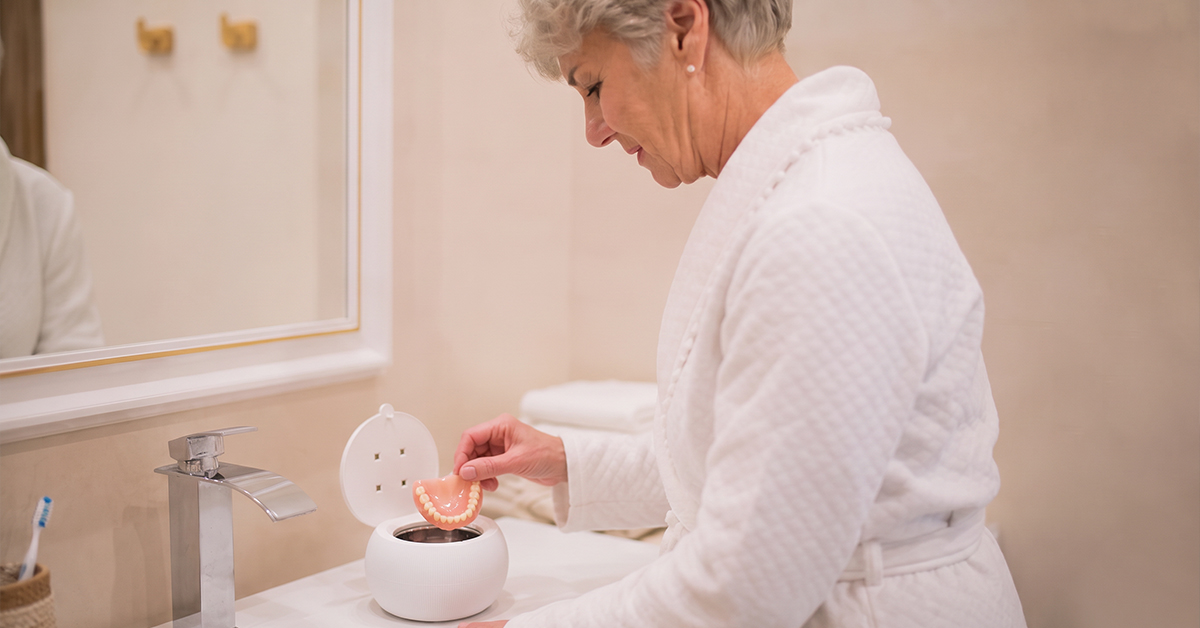
If you wear a retainer, a set of clear aligners or a night guard, you already know the problem. You rinse it every morning, you brush it, and by the end of the week there is still a cloudy film in the grooves and a smell you can taste when you put it back in. I went through the usual fixes first: soaking tablets, a vinegar bath, a stiffer toothbrush. None of them reached the places that matter. Bristles skate over the surface and leave fine scratches in the plastic, and a soak loosens some staining while the biofilm stays down in the crevices. 😬
That is why ultrasonic cleaning moved out of the dental office and onto bathroom counters. A cleaning pod drives the water at roughly 42,000 to 45,000 vibrations per second, and the microscopic bubbles that form and collapse against the appliance, a process called cavitation, reach into every groove a brush cannot. Newer machines add UV-C light on top of that, which handles the odor-causing bacteria agitation alone leaves behind. Ultrasonic action lifts the buildup; UV-C deals with what is living in it.
⚠️ The catch is that the category is now full of look-alike pods. Plenty run a weak transducer that barely disturbs the water, skip sanitizing entirely, or only perform as advertised with the brand’s own tablets, so a $100 machine turns into a $100 machine plus a refill bill. A few are scoped so tightly that they are approved for one company’s aligners and nothing else in your bathroom drawer.
I ran 31 cleaners through the same routine: a stained Essix retainer, a two-year-old night guard and a partial denture, one cycle a day for three weeks. What separated the top performers was not the frequency printed on the box, because almost every unit sits in the same 42 to 45 kHz band. What mattered was whether the machine sanitized as well as agitated, whether it ran on plain tap water instead of a proprietary tablet, and whether it was quiet and simple enough that I was still using it on day twenty-one. 🧪
🎯 Below are the five that earned a place, ranked, with the real trade-offs for each: what each one costs to keep running, what it will and will not clean, and who it actually suits. If you just want the appliance clean and the smell gone without adding another chore to your morning, start with the first one.

By Naomi Reyes
Naomi Reyes has spent 4 years testing 31 ultrasonic cleaners on retainers, clear aligners, night guards and full dentures. She looks at how much buildup a cycle actually removes, whether a machine sanitizes or only agitates, and how much effort it adds to a daily routine, helping aligner and denture wearers choose a cleaner they will still be using in a year.
Our Evaluation Standards
Cleaning Performance
Ultrasonic frequency, power delivery and cycle length were tested against a stained retainer, an old night guard and a partial denture to see how much buildup each cycle actually removed.
Sanitization & Hygiene
Whether the unit disinfects or only agitates, UV-C coverage and timing, tank material, and how easily the water chamber drains and dries between daily uses.
Ease of Use & Daily Convenience
Controls, cycle setup, running noise, counter footprint and travel readiness were reviewed to see how much effort each machine adds to an already busy morning.
Value & Running Costs
Purchase price was weighed against ongoing costs, including proprietary tablets or crystals, and how many different appliance types each machine is approved to clean.

from Clorant
Overall Grade
A+
Rating
9.6/10
OVERALL ANALYSIS
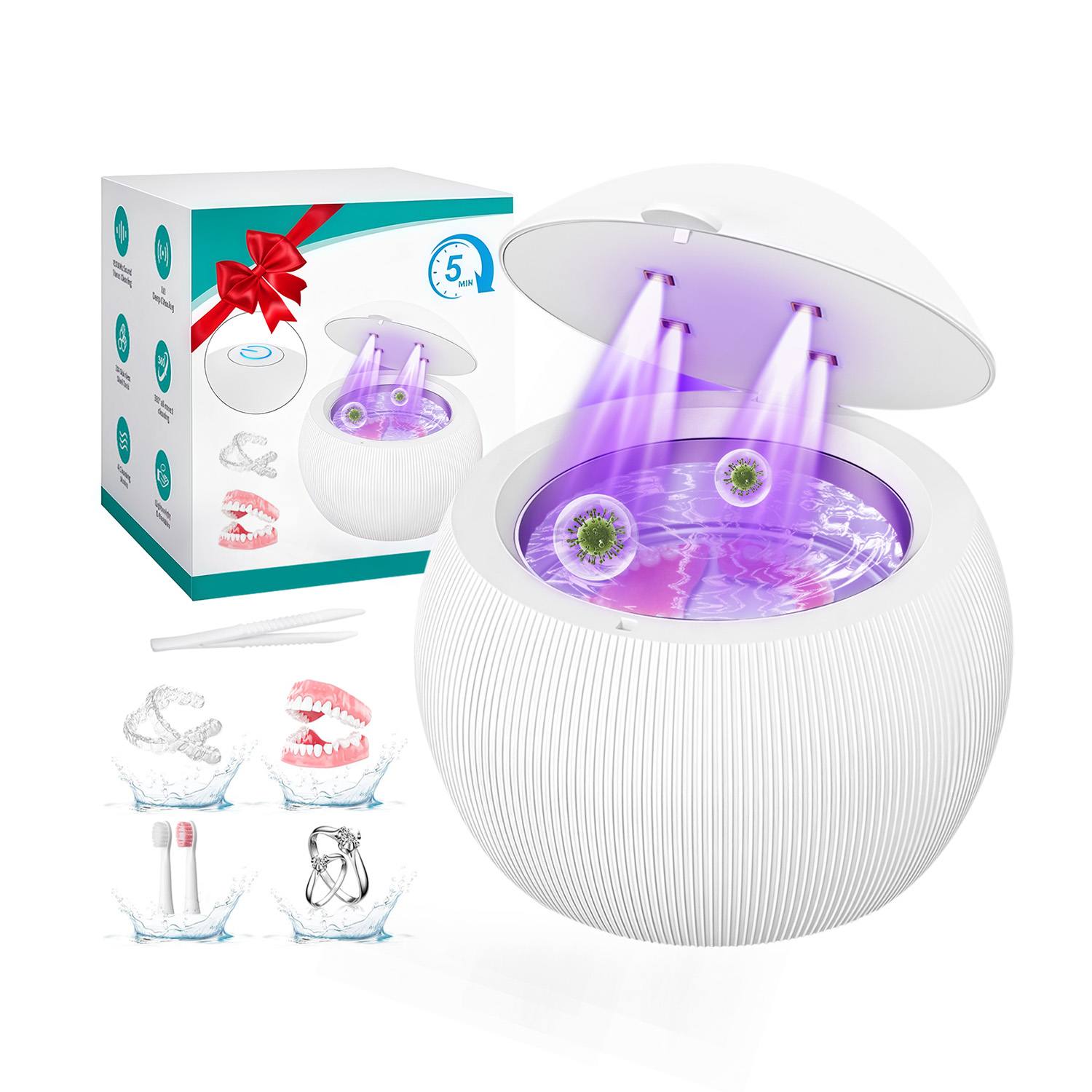
The Clorant Ultrasonic UV Retainer Cleaner is built for the person who wears something in their mouth every single day, whether that is a retainer, a set of clear aligners, a night guard or a full denture, and wants it clean without turning it into a project. Instead of a brush and a tub of tablets, you fill the tank with tap water, drop the appliance in and press one button. Five minutes later it comes out clean and, more to the point, sanitized. 🦷
What separates it from most pods at this price is that it does two jobs in the same cycle. The 42,000 Hz ultrasonic system drives cavitation bubbles into the grooves and around the wire work where a brush never reaches, while a 254 nm UVC lamp runs alongside it, rated by the manufacturer at 99.99% germ reduction. Most competitors do one or the other. Agitation on its own lifts visible film but leaves the bacteria behind the smell, and running both in a single five-minute cycle is what actually fixes the odor, not just the cloudiness.
It is also the least demanding machine here to live with. There is no proprietary tablet to buy, since plain tap water is enough for daily cleaning and you can add an effervescent tablet or cleaning solution when an older appliance needs one, so you are never locked into one brand’s refills. One-touch operation means there is no menu, no timer to set and nothing to remember. At 45 dB it is quiet enough to run on a nightstand while someone else is asleep in the room. 💦
At 11.4 oz it weighs less than a can of soda, which matters more than it sounds, because the appliance you clean on vacation is the one that stays in the routine. It is not scoped to a single brand either: retainers, Invisalign and other clear aligners, night guards, full and partial dentures and small jewelry all go in the same tank, so one machine covers the whole household rather than one person’s treatment plan. The honest trade-off is configurability. Clorant runs one fixed five-minute cycle rather than the 8 and 10-minute deep-clean settings some rivals offer, and the spec sheet does not publish a tank capacity or an IP rating, so stripping years of hardened staining off an old denture means running the cycle twice. Demand also outruns restocks periodically, and shipping can trail the bigger brands by a day or two.
In summary, the Clorant is the cleaner most people should buy, not because it wins on paper, but because it is the one still in use in week three. Tap water, one button, five minutes, and the appliance comes out both clean and sanitized. For the overwhelming majority of retainer, aligner and night guard wearers, that is the entire job. ✅
Pros
Kills the smell, not just the film – UVC runs with the ultrasonic cycle, so the bacteria a brush leaves behind get handled too
No tablets to buy – Plain tap water is enough for daily cleaning, with no proprietary refills
One-touch five-minute cycle – Nothing to set up, so it survives a real morning routine
42,000 Hz cavitation – Reaches the grooves and wire work a toothbrush skates over
Non-abrasive on plastic – No scrubbing, so aligners stay clear instead of clouding
Quiet at 45 dB – Runs on a nightstand without waking anyone
Travel-ready at 11.4 oz – Light enough to pack, so the routine does not stop on vacation
Fits every appliance – Retainers, aligners, night guards, full and partial dentures
Doubles as a jewelry cleaner – Same tank takes rings and chains, so it earns its counter space
Cons
Frequently out of stock – Demand outpaces restocks and shipping can run a day or two behind
THE RESULT
If you wear an appliance every day and you are tired of a brush that does not reach and a soak that does not fix the smell, the Clorant Ultrasonic UV Retainer Cleaner is the one to start with. It cleans and sanitizes in the same five-minute cycle, runs on tap water with nothing to reorder, and is quiet and light enough that it stays in the routine instead of in a cupboard. Other machines here give you more dials, a longer deep-clean setting or a more familiar name on the lid. For most retainer, aligner and night guard wearers, this is the one that does the whole job with the least friction. ✨

from Sonic Dental
Overall Grade
B+
Rating
9.3/10
OVERALL ANALYSIS
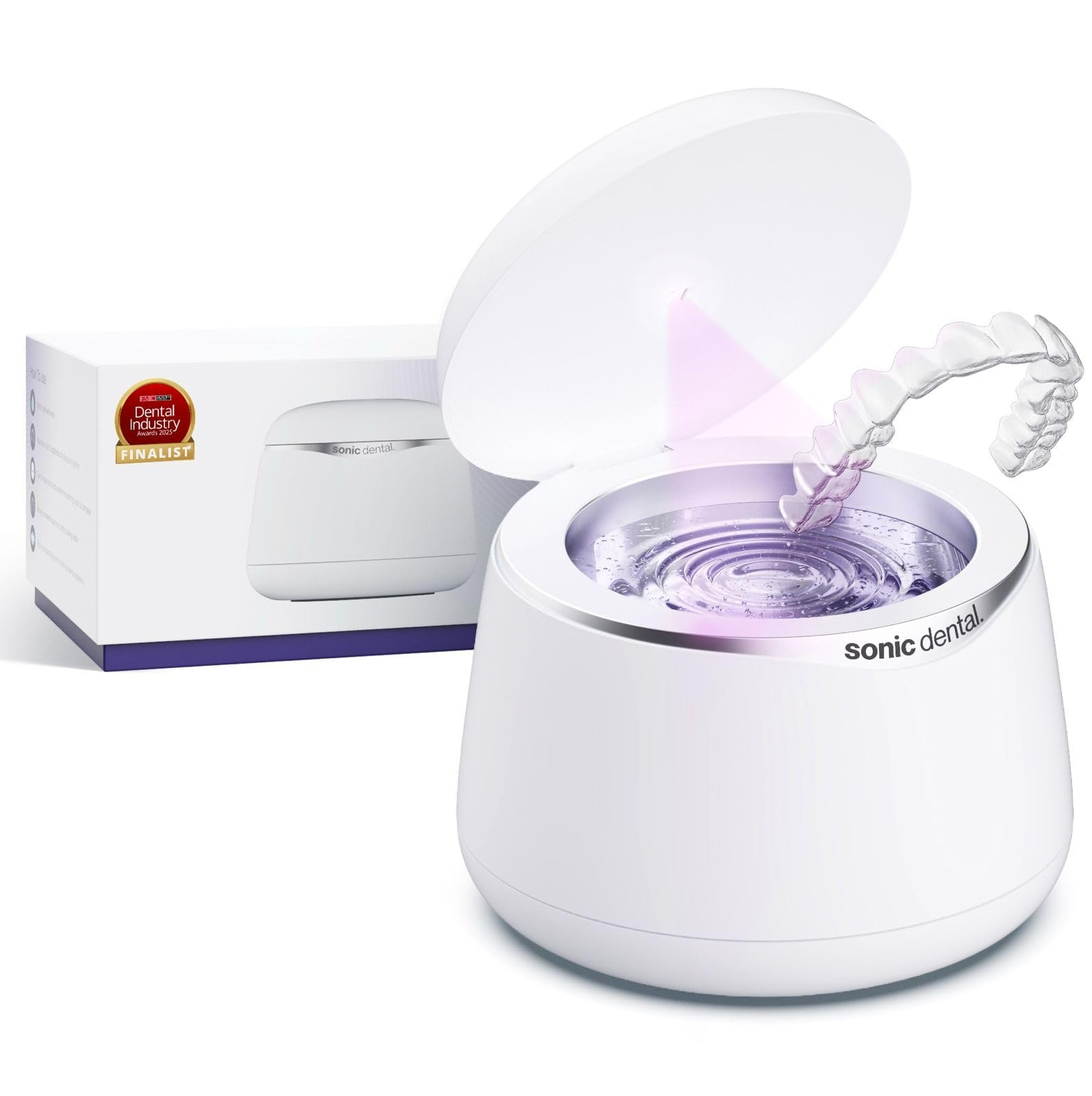
The Sonic Pro Dental Cleaning Pod is the closest thing here to a clinic device you can keep on a bathroom shelf. It was engineered and approved in the UK alongside dental professionals, and it is the only other machine in this group that pairs ultrasonic agitation with UV light instead of choosing one.
It runs at 43,000 Hz with an integrated UVC lamp, and gives you two cycles rather than one: a three-minute wash for daily use and a five-minute deep clean for an appliance that has been neglected. The tank is 165 ml stainless steel, the body measures 122 x 122 x 100 mm, and the pod is FSA/HSA eligible, which for a lot of US buyers takes a real chunk off the effective price. Sonic Dental sells its own Steribrite tablets, but the machine works without them.
The compromises show up in daily use. It is rated at under 65 dB, noticeably louder than the quietest pods here, which matters if the machine lives in a bedroom or gets run early. The 165 ml tank is on the small side for a full upper denture, and the two fixed cycles top out at five minutes, so genuinely stubborn staining means running it repeatedly rather than choosing a longer program. The brand also leans on its own tablets for its best-case results, which nudges the running cost up over time.
Overall, this pod is best suited for buyers who want a dentist-developed device with UV sanitizing built in and will trade a louder cycle and a smaller tank for that clinical pedigree, particularly anyone paying with an FSA or HSA card, where the real cost lands well below the sticker.
Pros
Ultrasonic plus UVC – Cleans and sanitizes in the same cycle
Two cycle lengths – Three minutes daily, five minutes for a deeper clean
Dentist-developed – Engineered and approved in the UK with dental professionals
Stainless steel tank – 165 ml chamber rinses and dries easily
FSA/HSA eligible – Effective cost drops for US buyers using pre-tax funds
No tablets required – Steribrite tablets are optional, not mandatory
12-month warranty – Backed by UK and US support teams
Cons
Louder in use – Rated under 65 dB, the noisiest cycle in this group
Small 165 ml tank – Tight for a full upper denture
Five-minute maximum – No longer deep-clean program for heavy staining

from Eonini
Overall Grade
B+
Rating
8.9/10
OVERALL ANALYSIS
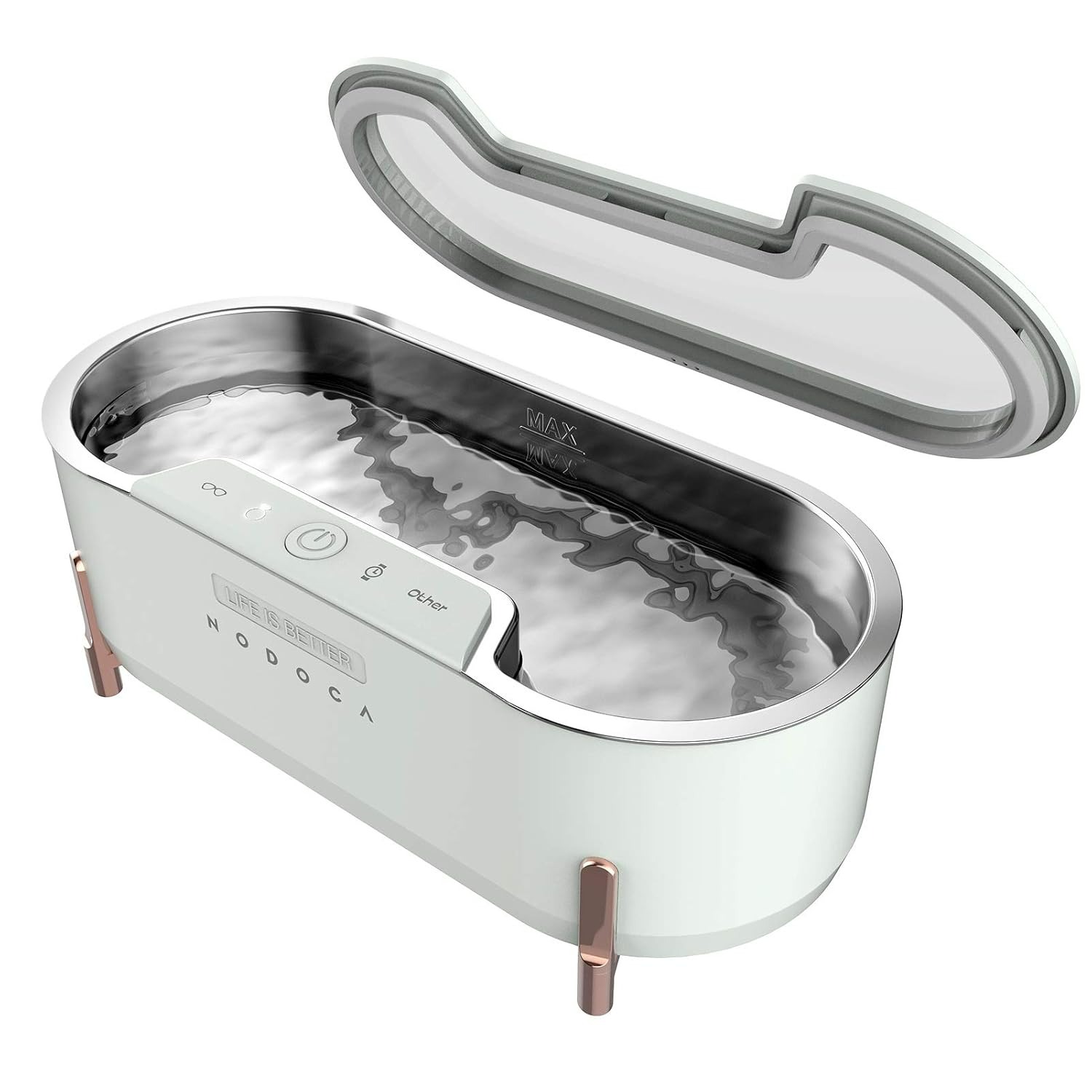
The Eonini Ultrasonic Retainer Cleaner is for people who would rather control the cycle than press one button and walk away. It runs at 45,000 Hz with four UV lamps that fire once the lid is closed, and a touch display counts down a 300, 450 or 600 second cycle.
Two design choices set it apart. The 180 ml inner tank lifts out, so you fill and empty it at the sink instead of carrying the whole unit, and lifting it mid-cycle pauses the run and resumes when you put it back. A sliding dual-window design lets you clean toothbrush heads vertically with the windows open, or close them and drop running noise from about 45 dB to 30 dB, which makes it the quietest machine here.
The cost is bulk and complexity. At roughly 5.8 x 5.5 x 5.5 inches and 1.48 lb it is the largest unit in this group and not something you drop into a wash bag. The display and three cycle lengths are genuine features, but they are also three more decisions in a routine most people want to be automatic, and Eonini recommends changing the water after every cycle. Overall, this cleaner is best suited for someone who wants a near-silent machine with a removable tank and adjustable cycles in a fixed spot on the bathroom counter, but it is more device than a straightforward daily clean requires.
Pros
Quietest in this group – Drops to about 30 dB with the windows closed
Removable 180 ml tank – Fill and empty at the sink without moving the unit
Three cycle lengths – 5, 7.5 or 10 minutes depending on how dirty it is
Four UV lamps – Sanitizing runs automatically once the lid is closed
Smart pause – Lift the tank to stop the cycle, drop it back to resume
Digital display – Shows remaining time at a glance
Cons
Largest footprint – Roughly 5.8 inches square and 1.48 lb, awkward to travel with
More steps than needed – Mode and timer choices on a task most want automatic
Water change every cycle – The maker’s own recommendation adds a daily chore
Counter-bound design – Built for a fixed bathroom spot rather than a bag

from Zima Dental
Overall Grade
C+
Rating
8.6/10
OVERALL ANALYSIS
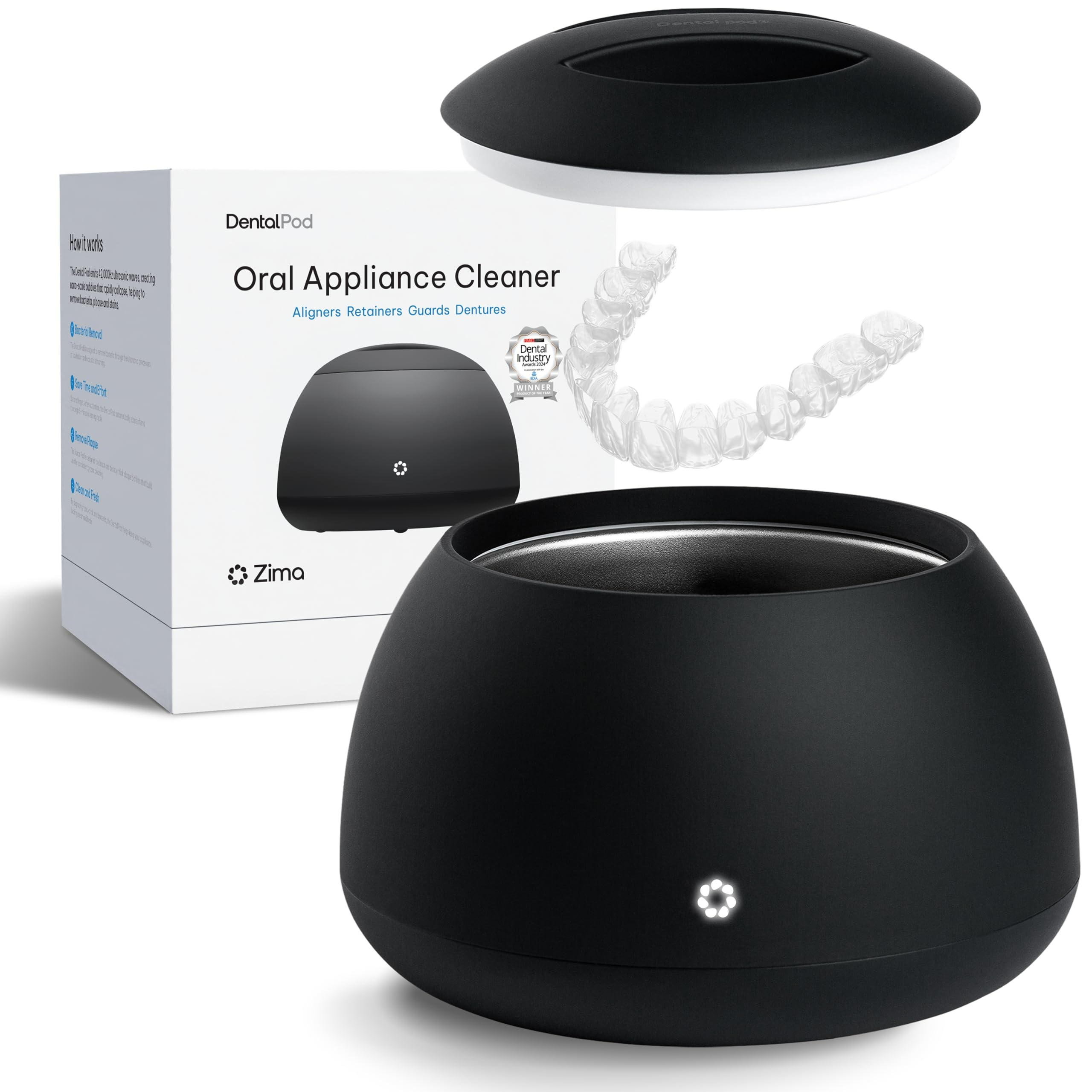
The Zima Dental Pod is the original in this category and still the name dentists say out loud. It is a UK-designed 42,000 Hz ultrasonic pod with a 150 ml stainless steel tank, a single five-minute cycle and a low-profile shell that does not look like medical equipment on a shelf.
The credibility behind it is real rather than marketing. Zima lists a 4.9 out of 5 average across close to 12,000 reviews, the Dental Pod took Product of the Year at the 2024 Dentistry Industry Awards alongside the British Dental Industry Association, and named clinicians at UK practices recommend it directly to patients. It is validated across Invisalign, Byte, Hawley, Essix and Vivera appliances, hard and soft night guards and full dentures, so compatibility is not in question.
What it does not do is sanitize. The base Dental Pod is ultrasonic only, with no UV-C lamp, so it lifts plaque and staining but does not address the bacteria behind the odor the way the dual-action machines above do. Zima also points buyers toward its own cleaning tablets for stubborn stains, which turns a roughly $100 to $110 purchase into a recurring cost. The 150 ml tank is the smallest here, the base model’s tank does not lift out so you unplug the unit to empty it, and the cycle is fixed at five minutes with no deeper setting.
Overall, this pod is best suited for buyers who want the dentist-endorsed original and are comfortable paying a premium for that reassurance, provided they do not mind cleaning without a sanitizing step and buying tablets to get the results the brand shows.
Pros
Dentist-recommended original – Award-winning and sold through UK clinics
Proven 42,000 Hz cleaning – Non-abrasive on aligner plastic and metal retainers
Broad appliance validation – Tested across Invisalign, Byte, Hawley, Essix and Vivera
Stainless steel tank – Rinses clean and wipes dry easily
Strong owner feedback – 4.9 out of 5 across nearly 12,000 reviews
Cons
No UV-C sanitizing – Cleans and agitates, but does not disinfect
Tablets pushed for results – Ongoing cost on top of a $100+ machine
Smallest 150 ml tank – Tight for larger dentures
Fixed five-minute cycle – No deep-clean setting for older staining
Tank does not lift out – Unplug the unit to empty it
Premium price – Around $100 to $110, the most expensive here

Overall Grade
C
Rating
8.2/10
OVERALL ANALYSIS
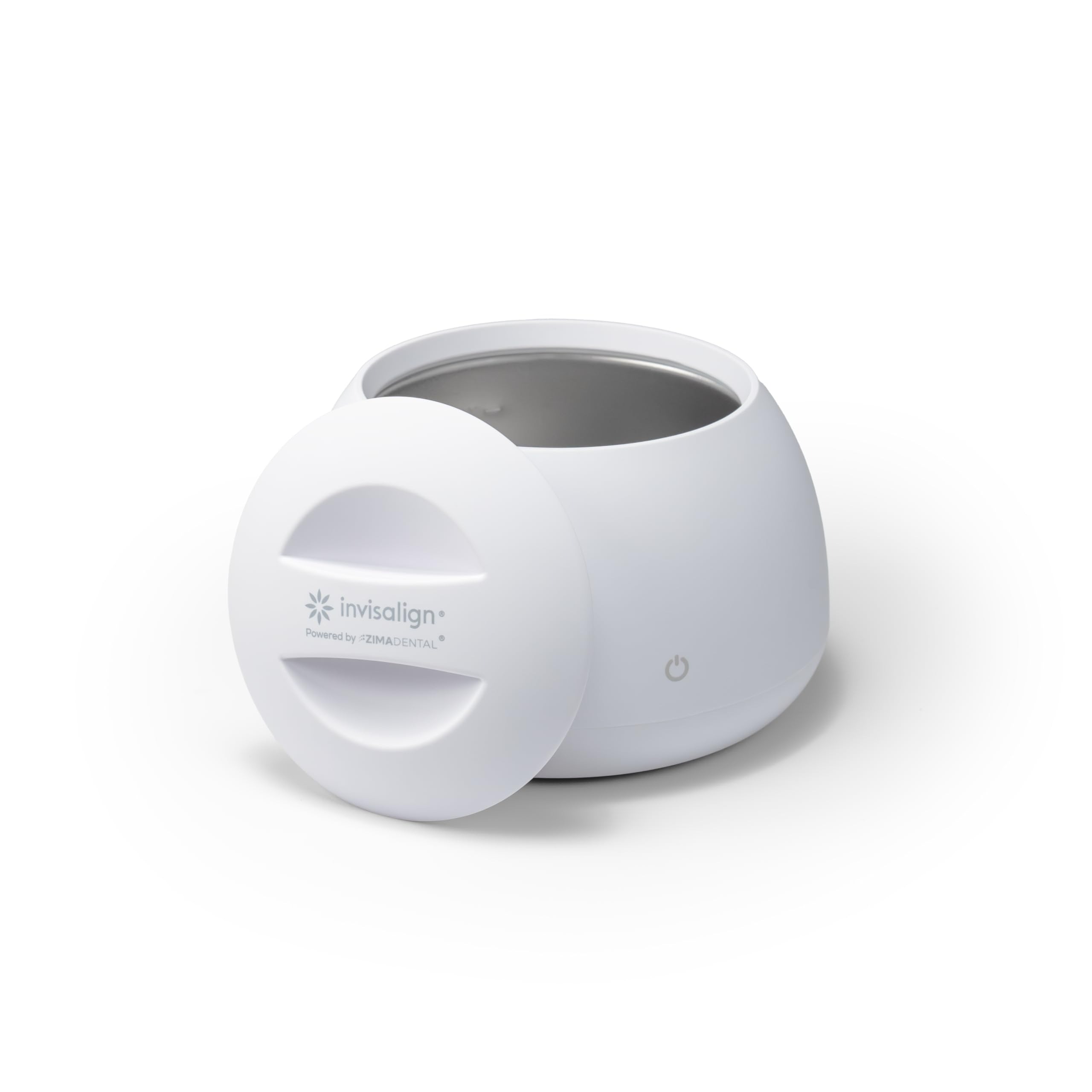
The Invisalign Ultrasonic Cleaner is the accessory Align Technology sells to its own patients, built by Zima Dental under the Invisalign name. It uses the same 42,000 Hz cavitation and the same one-touch five-minute cycle as the Zima pod, in Invisalign packaging, at $99.99.
For someone mid-treatment the appeal is obvious. It is the cleaner a provider is most likely to mention, it is designed around the exact appliances you already have, and adding 5 g of Invisalign Cleaning Crystals+ to the tank is the manufacturer’s own routine rather than a third-party workaround. The cycle stops on its own, so there is nothing to time.
The scope is where it gets restrictive. Officially it is an over-the-counter device intended for Invisalign clear aligners and Vivera retainers, not your partner’s night guard, not a denture and not an Essix retainer from another practice. The instructions cap the tank at two aligners per cycle, placed unstacked and inside-up, and the unit has to be unplugged and emptied after every run. There is no UV sanitizing, the Crystals+ are a recurring cost, and you are paying close to $100 for a single-appliance machine when the same underlying hardware sells for less under other names. Align also advises against use by anyone with a pacemaker.
Overall, this cleaner is best suited for Invisalign patients who want the brand’s own accessory and plan to use Cleaning Crystals+ as directed, but anyone with a mixed household of appliances will get more machine for the money elsewhere.
Pros
Made for Invisalign wearers – Designed around Invisalign aligners and Vivera retainers
Zima hardware underneath – The same proven 42,000 Hz cleaning platform
One-touch five-minute cycle – Starts and stops on its own
Official cleaning routine – Crystals+ dosing is the manufacturer’s own instruction
Cons
Single-brand scope – Not intended for night guards, dentures or other retainers
Two aligners per cycle – Tank limit means separate runs for a couple
No UV sanitizing – Ultrasonic only, so odor-causing bacteria are not addressed
Crystals+ as a recurring cost – Deeper cleaning depends on buying refills
$99.99 for one job – The priciest here per appliance type it can clean
❓ What Is an Ultrasonic Retainer Cleaner
An ultrasonic retainer cleaner is a small water-filled pod that uses high-frequency sound waves, typically between 42,000 and 48,000 Hz, to clean dental appliances without scrubbing. The vibrations create millions of microscopic bubbles in the water. Those bubbles collapse against the surface of the appliance in a process called cavitation, and the resulting shockwaves lift plaque, biofilm and staining out of grooves a toothbrush cannot reach.
The same technology has been used in dental practices and laboratories for decades. What changed recently is size and price: a countertop pod now costs a fraction of a clinic unit and completes a full cycle in three to ten minutes. Because the cleaning is done by the water rather than by bristles, it is non-abrasive, which matters for clear aligners and retainers that scratch easily and go cloudy once they do.
Many current models add a second mechanism. UV-C light at around 254 nm targets the bacteria behind the odor, which ultrasonic agitation alone does not fully address. That is the main dividing line in this category: ultrasonic-only pods clean, while ultrasonic-plus-UV pods clean and sanitize. Tank capacity, usually between 150 ml and 250 ml, decides what actually fits, since a full upper denture needs more room than a single aligner.
Most units are designed to run on plain tap water, with an optional cleaning tablet for heavier staining. Some brands make those tablets close to mandatory, so it is worth checking before you buy whether the machine performs properly without them. A good cleaner takes one button, one tank of water and five minutes, and it replaces brushing, overnight soaking and the guesswork about whether an appliance is genuinely clean.
✅ Benefits of an Ultrasonic Retainer Cleaner
Reaches what a brush cannot – Cavitation bubbles get into the grooves, wire work and clasps that bristles skate straight over.
Stops the smell at the source – Removing biofilm rather than rinsing around it addresses the odor and taste that come back every afternoon.
No scrubbing, no scratches – The water does the work, so aligners and retainers stay clear instead of clouding from abrasion.
Cuts the routine to five minutes – One hands-off cycle replaces brushing and overnight soaking, which means it actually gets done daily.
Protects an expensive appliance – Retainers and aligners cost real money to replace, and buildup is a common reason they get replaced early.
Supports better oral health – A clean appliance puts fewer bacteria back against your gums for the eight to twenty-two hours a day you wear it.
Works on more than dental appliances – Most tanks also take toothbrush heads, rings and chains, so the machine earns its counter space.
Keeps the routine going on the road – Compact models travel, and a hotel bathroom is where a proper clean is otherwise hardest.
🔍 Things To Consider When Choosing an Ultrasonic Retainer Cleaner
Frequency and power – Most pods sit between 42 kHz and 48 kHz, so check the wattage too, since frequency alone does not tell you how much energy reaches the water.
Whether it sanitizes – Decide early between ultrasonic only and ultrasonic plus UV-C, because that single feature separates cleaning from disinfecting.
Tank size and material – 150 ml is fine for aligners but tight for a full denture, and stainless steel rinses and dries more hygienically than plastic.
Running costs – Check whether the machine works on tap water or whether the brand’s own tablets or crystals are needed to get the results shown.
Appliance compatibility – Some cleaners are approved for one company’s aligners only, while a mixed household needs one that takes retainers, guards and dentures.
Noise and placement – Ratings range from about 30 dB to under 65 dB, which matters if the pod lives in a bedroom or gets used early in the morning.
Cycle options and auto-shutoff – A fixed five-minute program suits daily use, a longer setting helps with older appliances, and auto-shutoff means nothing to time.
⚠️ What To Avoid When Choosing an Ultrasonic Retainer Cleaner
Avoid tablet-locked machines – Skip any pod that only performs as advertised with the brand’s own refills, because the running cost outlives the purchase price.
Be wary of single-brand scoping – A cleaner approved for one company’s aligners becomes far less useful the moment treatment ends or another appliance joins the drawer.
Skip pods with no sanitizing step – Agitation removes visible buildup, but without UV-C the bacteria behind the odor stay exactly where they are.
Avoid vague power claims – Listings that quote a frequency but no wattage, tank capacity or cycle length are usually covering for a weak transducer.
Do not buy on price alone – The cheapest units drop the stainless tank and the auto-shutoff, and a pod that barely disturbs the water is a $25 lesson.
By Naomi Reyes
Naomi Reyes has spent 4 years testing 31 ultrasonic cleaners on retainers, clear aligners, night guards and full dentures. She looks at how much buildup a cycle actually removes, whether a machine sanitizes or only agitates, and how much effort it adds to a daily routine, helping aligner and denture wearers choose a cleaner they will still be using in a year.